
Transparent enough to challenge.
Climate intelligence should expose the source, method, assumption and reviewer behind material outputs.
Climate & scenarios
Physical and transition risk workflows can be configured around recognised scenario sources, time horizons and sensitivities. Scenario analysis is not a forecast. Downscaling can inherit source-model bias and needs validation appropriate to the use.
Accounting & finance
GHG Protocol-based inventory workflows, ISO 14040/14044-aligned life cycle assessment, PCAF portfolio accounting and financial-impact translation.
Nature & water
TNFD-aligned scoped applications following the LEAP approach, and water intelligence, with location-specific evidence and specialist interpretation.
Disclosure
IFRS S1/S2, AASB S2/ASRS, TCFD, CSRD/ESRS and CDP, with jurisdiction-aware configurations. Software mapping is not a legal determination.
Human governance
Agents propose. Authorised people confirm. Material judgements remain reviewable and accountable.
Assurance readiness
Data lineage, calculation rules, assumptions, approvals and evidence are retained to support review. An independent practitioner determines any assurance conclusion.
Source / method / assumption / reviewer.
- Source lineage: retain originating records, units, boundaries and periods; reconcile key inputs before they become accepted evidence.
- Visible methods: review factor mappings, calculation rules and model assumptions.
- Scientific context: inspect model sources, resolution, uncertainty and validation relevant to the use.
- Human governance: define owners and approvals for material inputs and conclusions.

Plain about limits
No guaranteed outcomes
No guaranteed savings, universal compliance or independent platform validation is implied. Avoided loss is a scenario estimate, not a realised saving.
No replacement for judgement
Independent assurance, regulatory applicability and financial decisions require appropriately qualified judgement.
Illustrative visuals
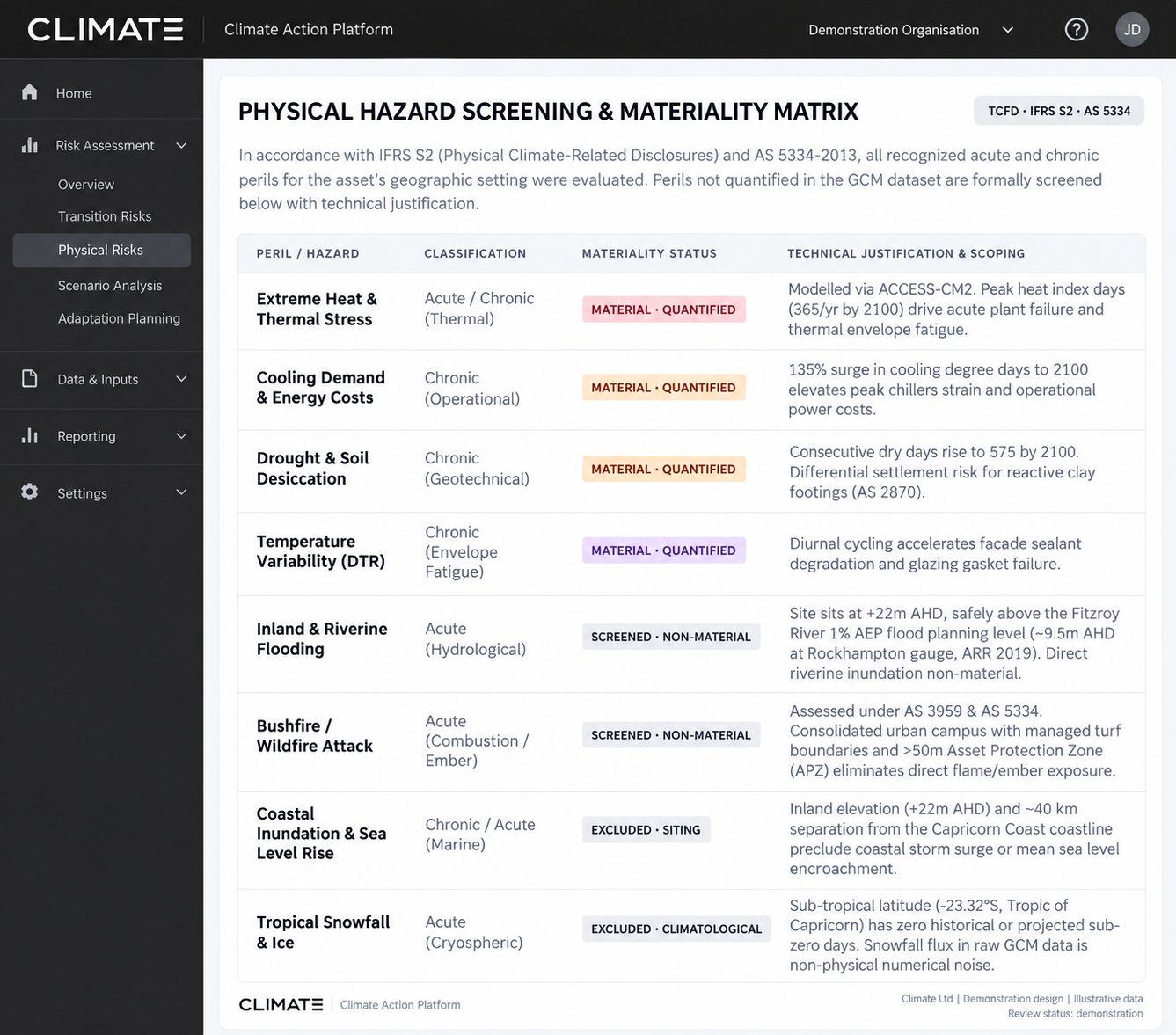
Platform screens are demonstration designs with illustrative data. They are not customer outcomes or verified live captures.
Bring one climate workflow. We will show how the agents connect it.
Start with an emissions inventory, a physical-risk assessment, a PCAF portfolio, a TNFD scope, a water-risk question, a disclosure programme or a client advisory workflow.
Request a demo