Home / Platform
The Climate Action Platform

Everything from raw data to a filed disclosure — on one platform.

Four stages, one data spine: collect and connect the data, calculate the inventory, model risk and decarbonisation, then report and assure. Nothing gets rebuilt by hand between stages.

01

Collect & connect data

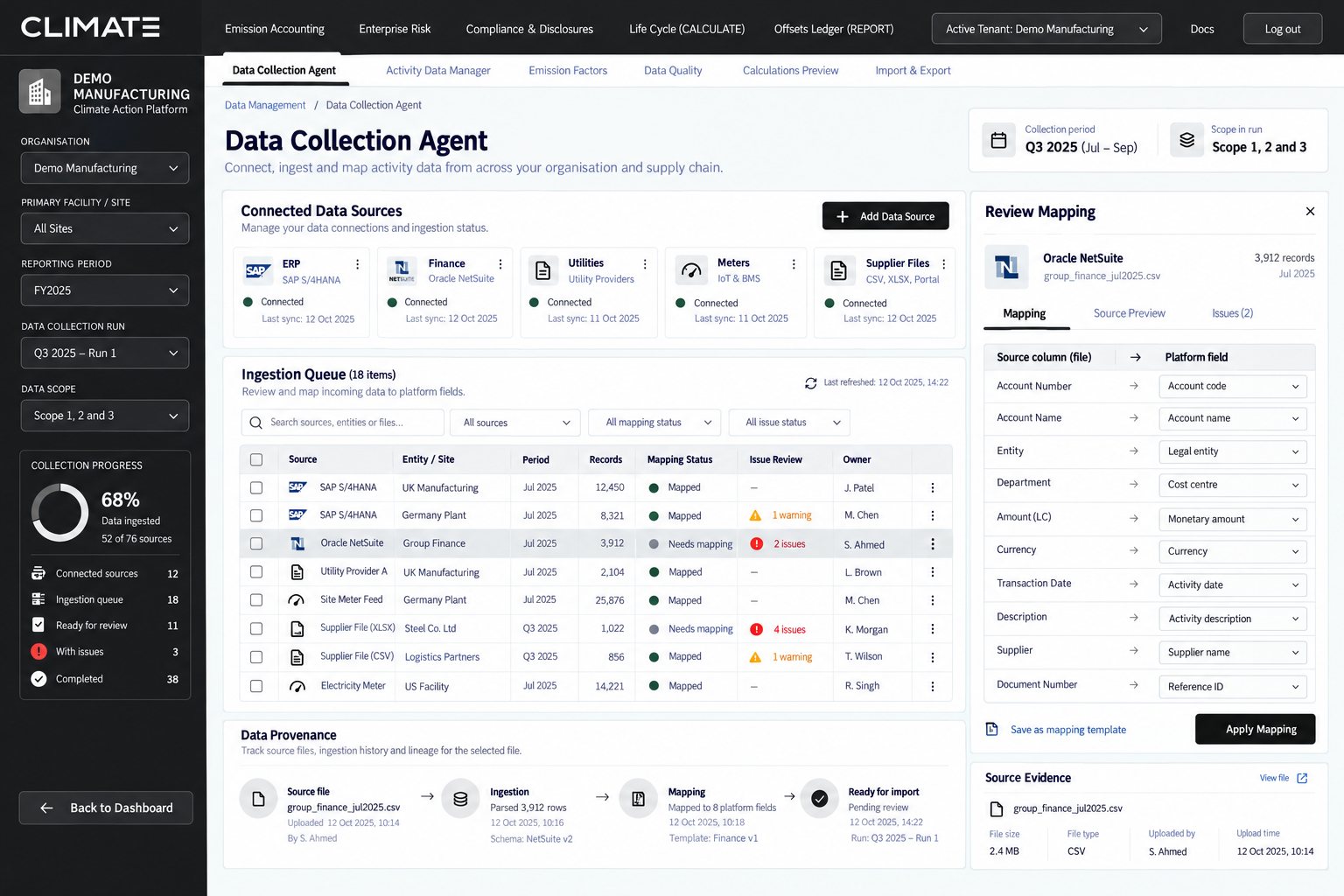
Automated data import

Streamline emissions data intake with structured, controlled import.

  • Import spreadsheets, PDFs and scanned documents, with column mapping and issue review before anything is confirmed
  • Connect ERP, finance, utility, spend and metered-data systems so records flow in continuously rather than once a year
  • API access for teams who want to push data programmatically from existing systems
  • Every import is normalised, deduplicated and cross-checked against prior periods automatically

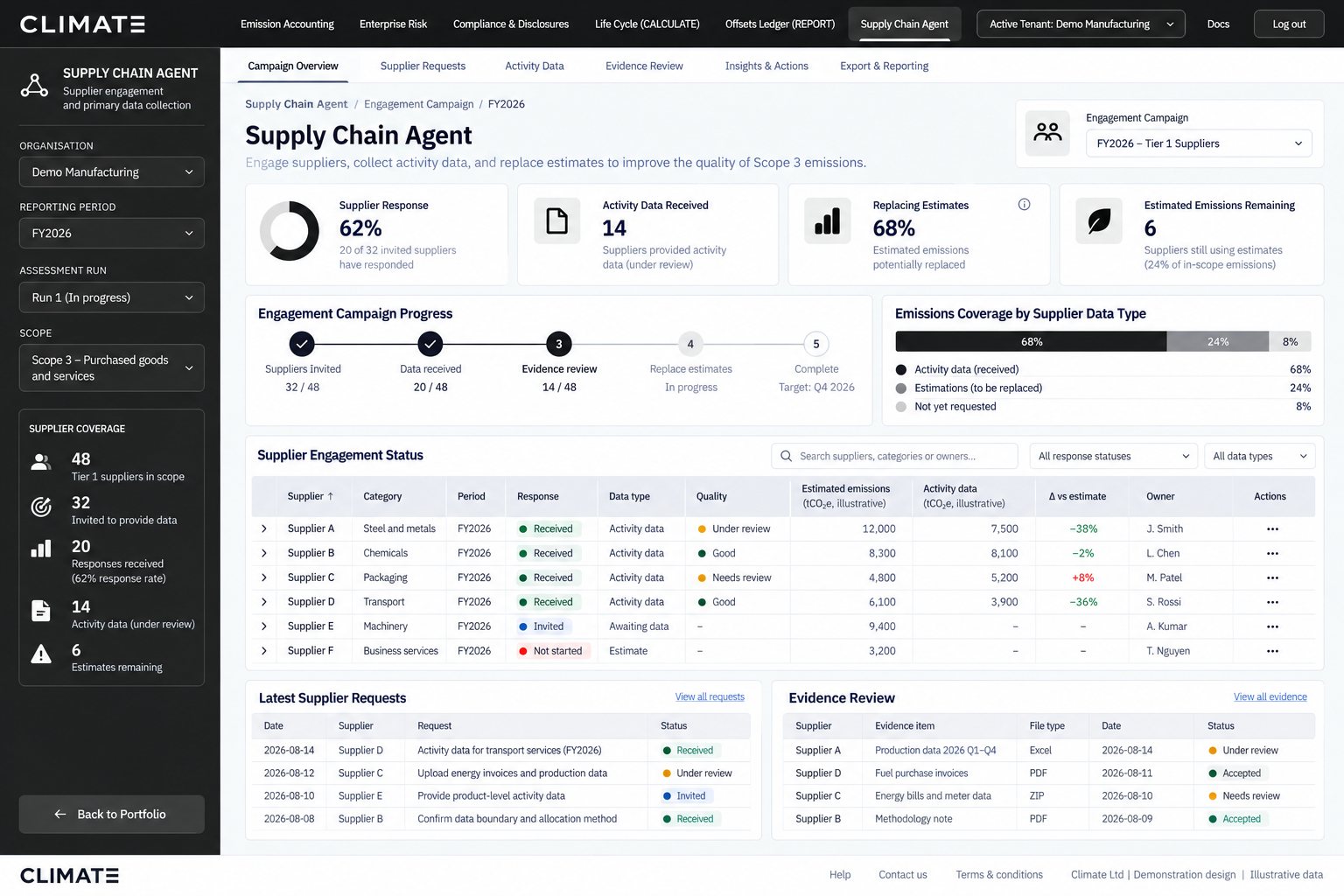
Supplier engagement

Replace spend-based estimates with supplier-reported primary data.

  • Send data requests directly from the platform, in plain language suppliers can actually answer
  • Track response time, completion rate and data quality per supplier, per campaign
  • Bulk upload received activity data and reconcile it straight into the scope 3 inventory
  • Give key suppliers limited platform access so data flows in rather than round-tripping by email
02

Calculate the inventory

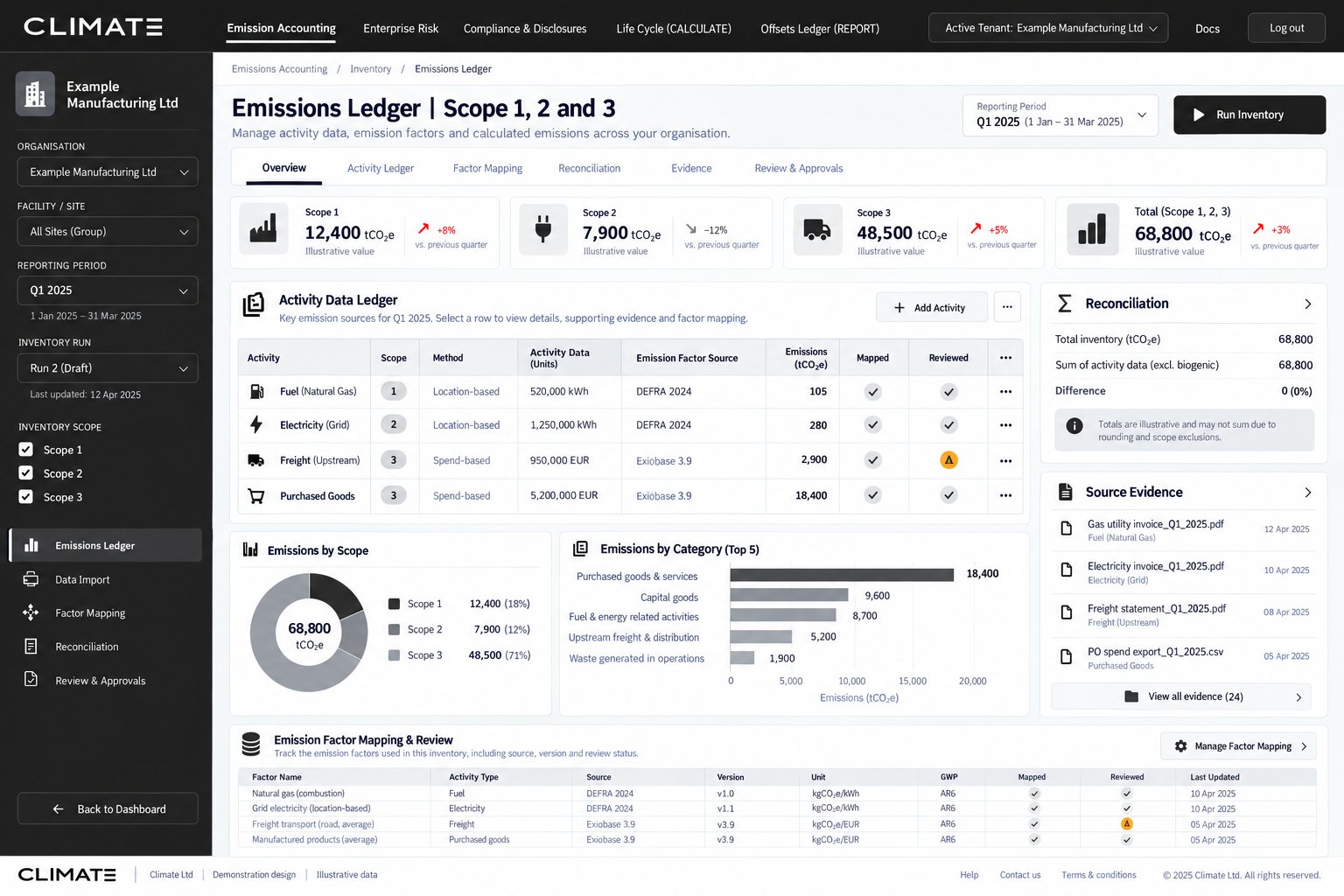
Scope 1, 2 & 3 emissions accounting

Accurate, continuously reconciled, and reused across every downstream output.

  • Spend-based, activity-based and supplier-specific calculation methods, applied consistently and reused across periods
  • A continually maintained library of activity-based, regional and supplier-specific emission factors, alongside support for your own licensed or custom factors
  • Every mapping between an activity and an emission factor is reviewable, confirmed and reused — not silently re-guessed each cycle
  • Reconciled to the GHG Protocol Corporate Standard and Corporate Value Chain (Scope 3) Standard

Life cycle assessment

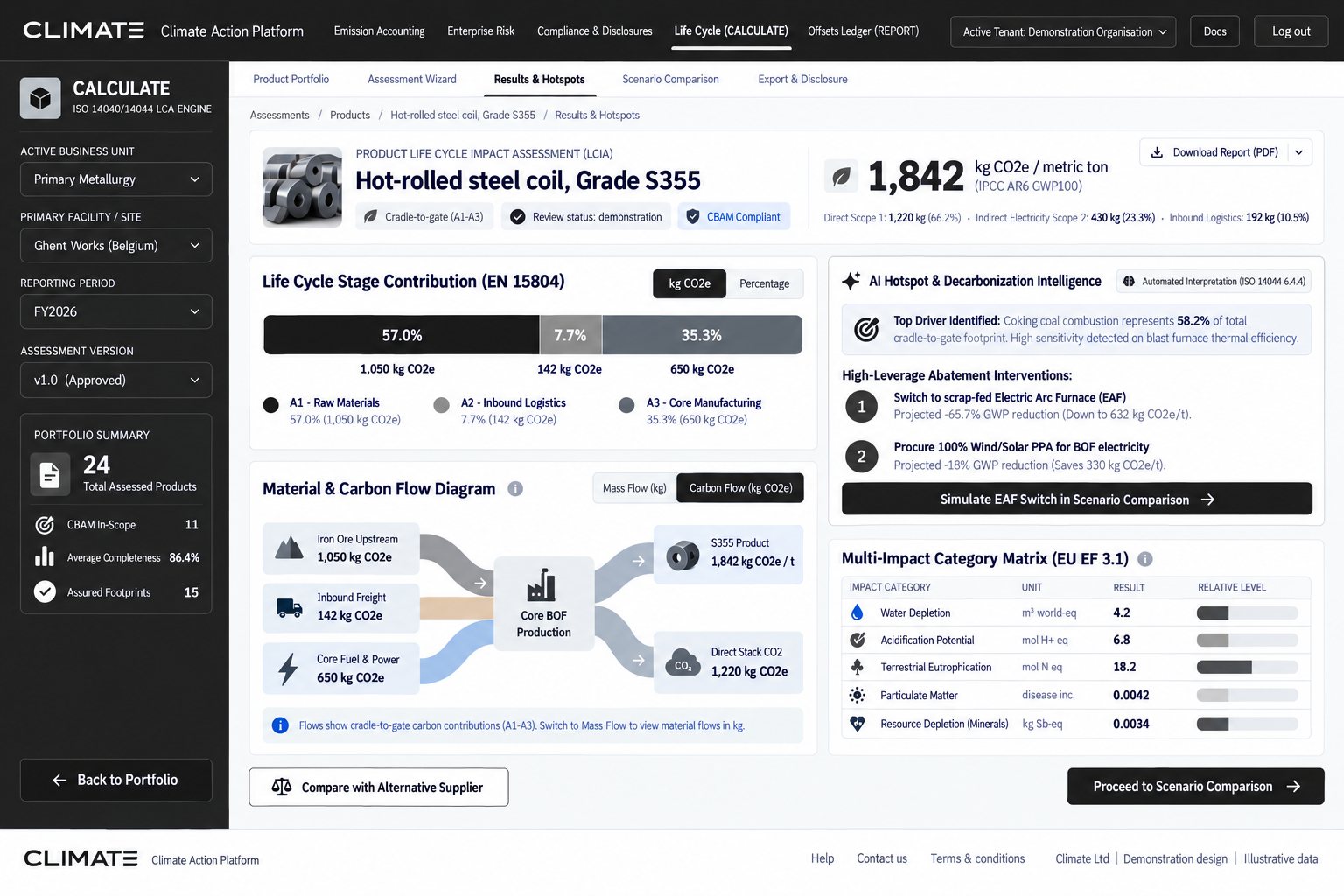
Product and material footprints, without a separate specialist model.

  • Cradle-to-gate or cradle-to-grave boundaries, aligned to ISO 14040/14044
  • Built on the same activity data and emission factors as the corporate inventory, so results stay consistent
  • Product-level results roll up into scope 3 categories automatically
03

Model risk & decarbonisation

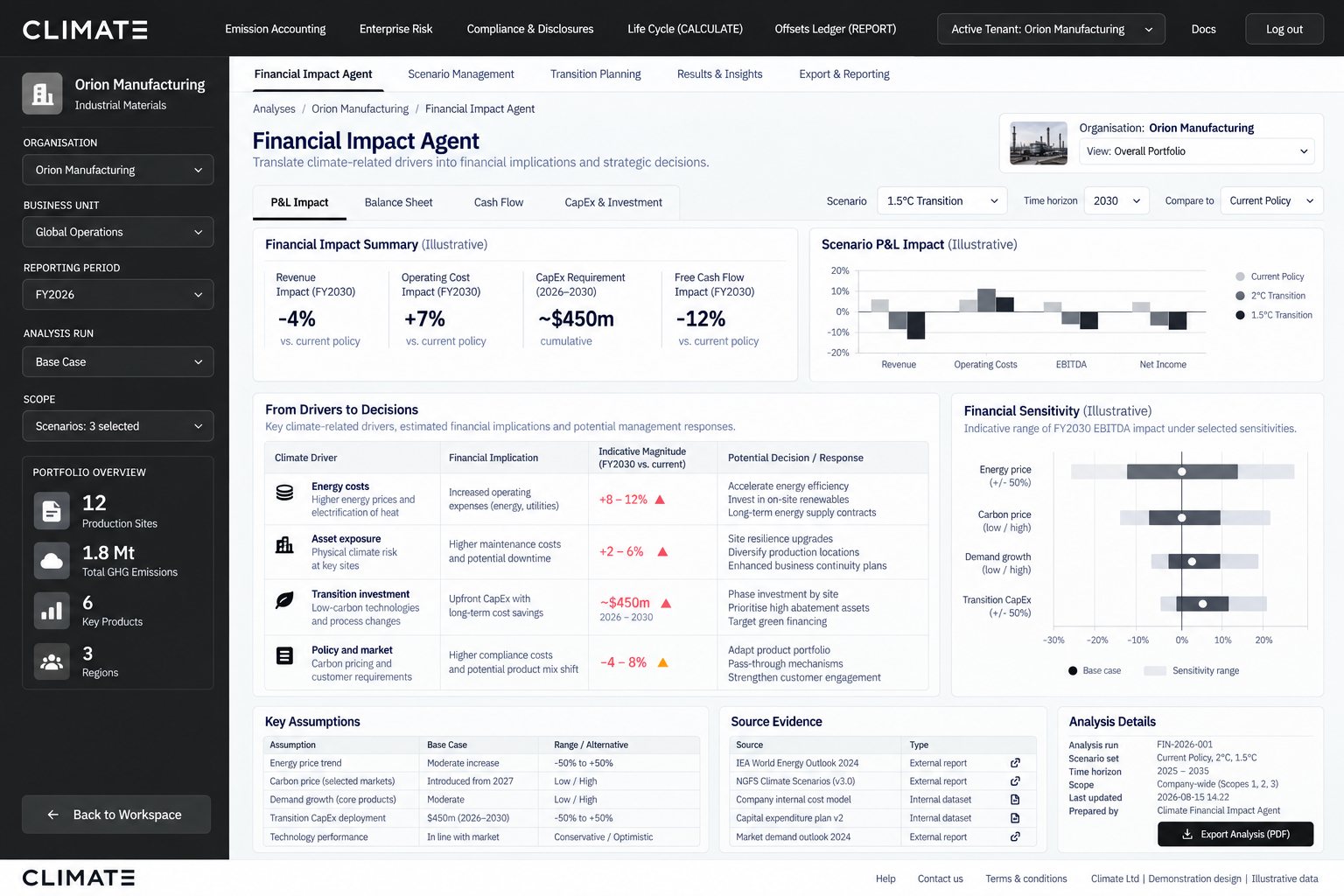
Transition & physical risk

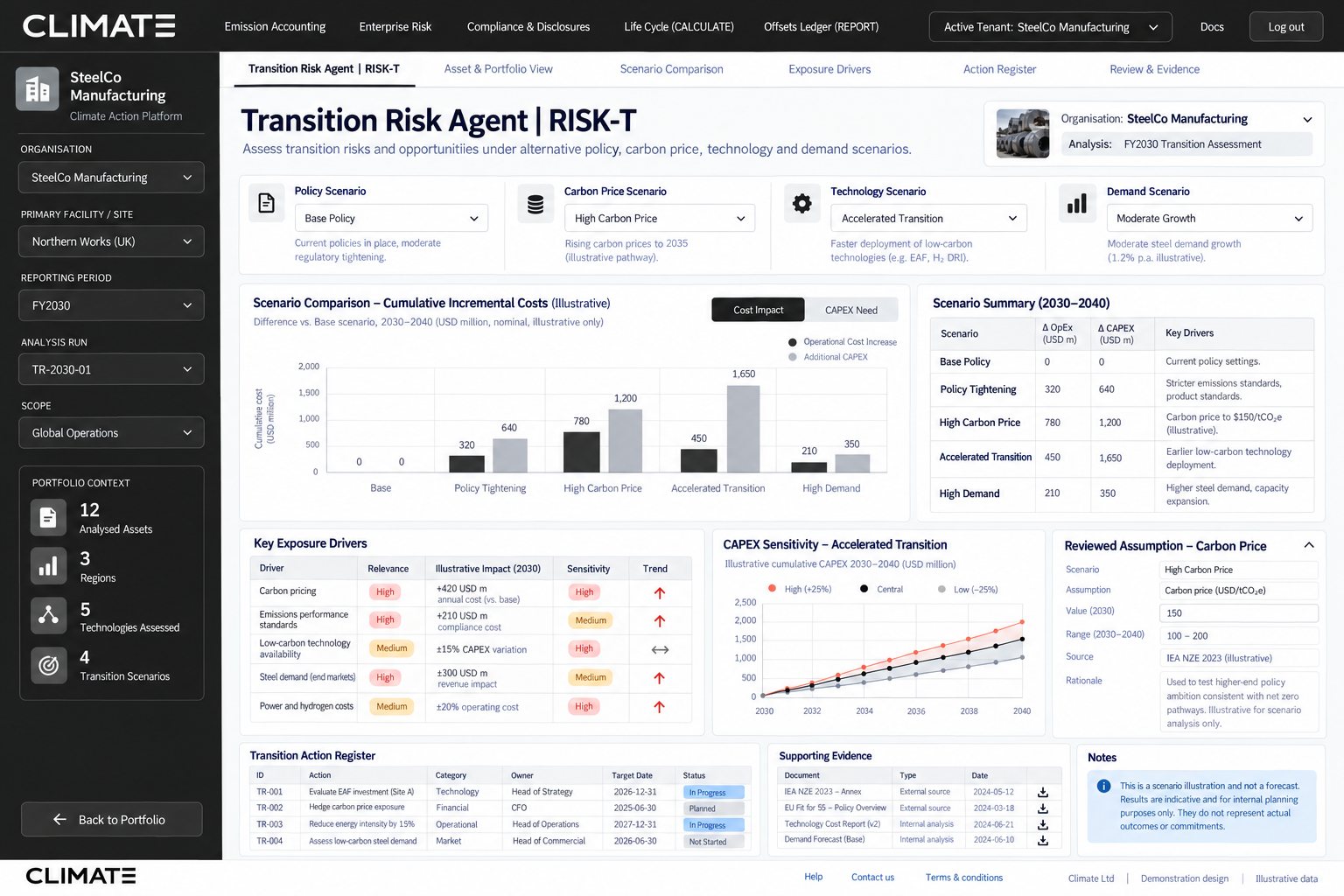
Scenario-modelled across the organisation, its assets, services and supply chain.

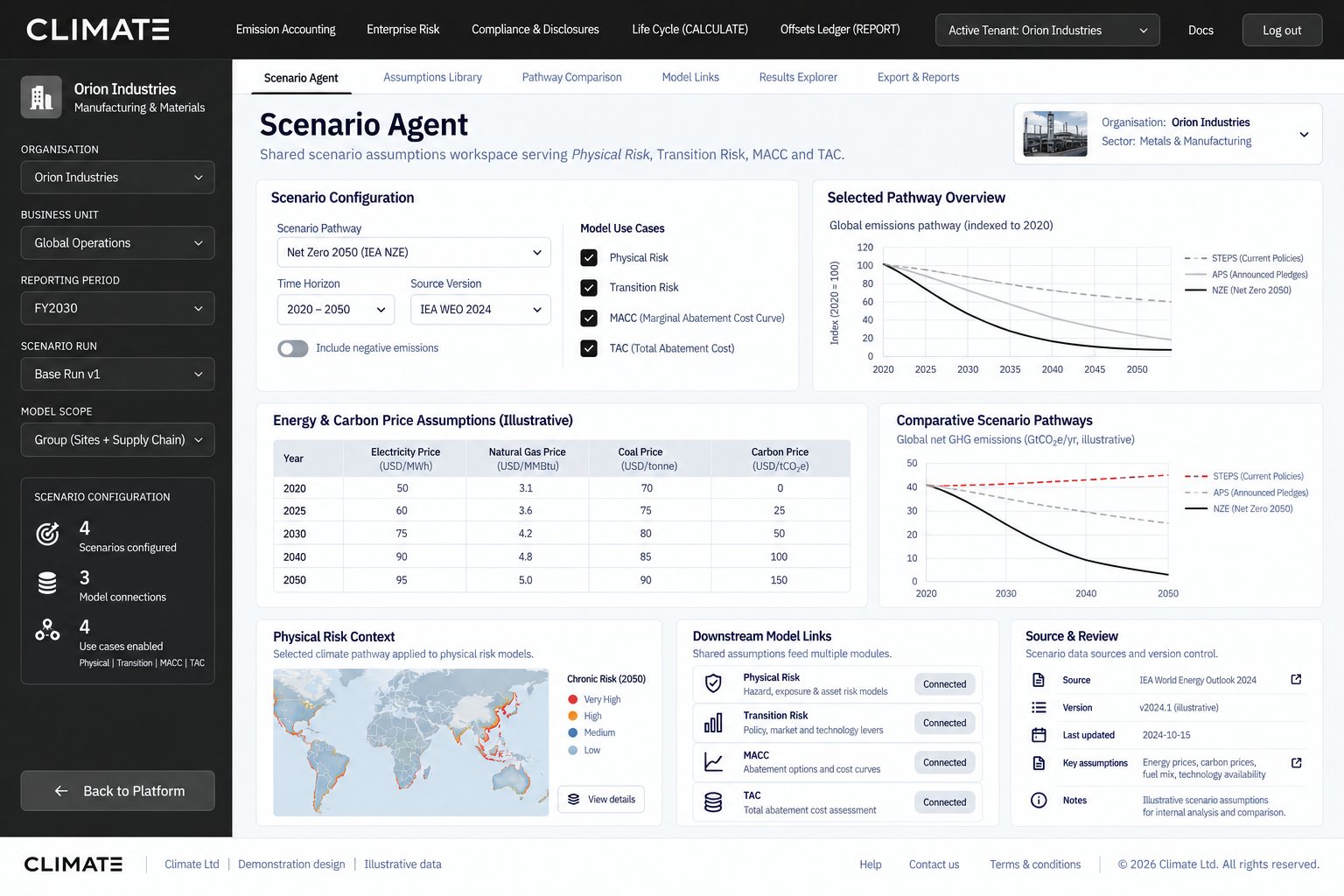
  • NGFS and IEA-aligned transition scenarios covering policy, carbon price, technology and demand shifts
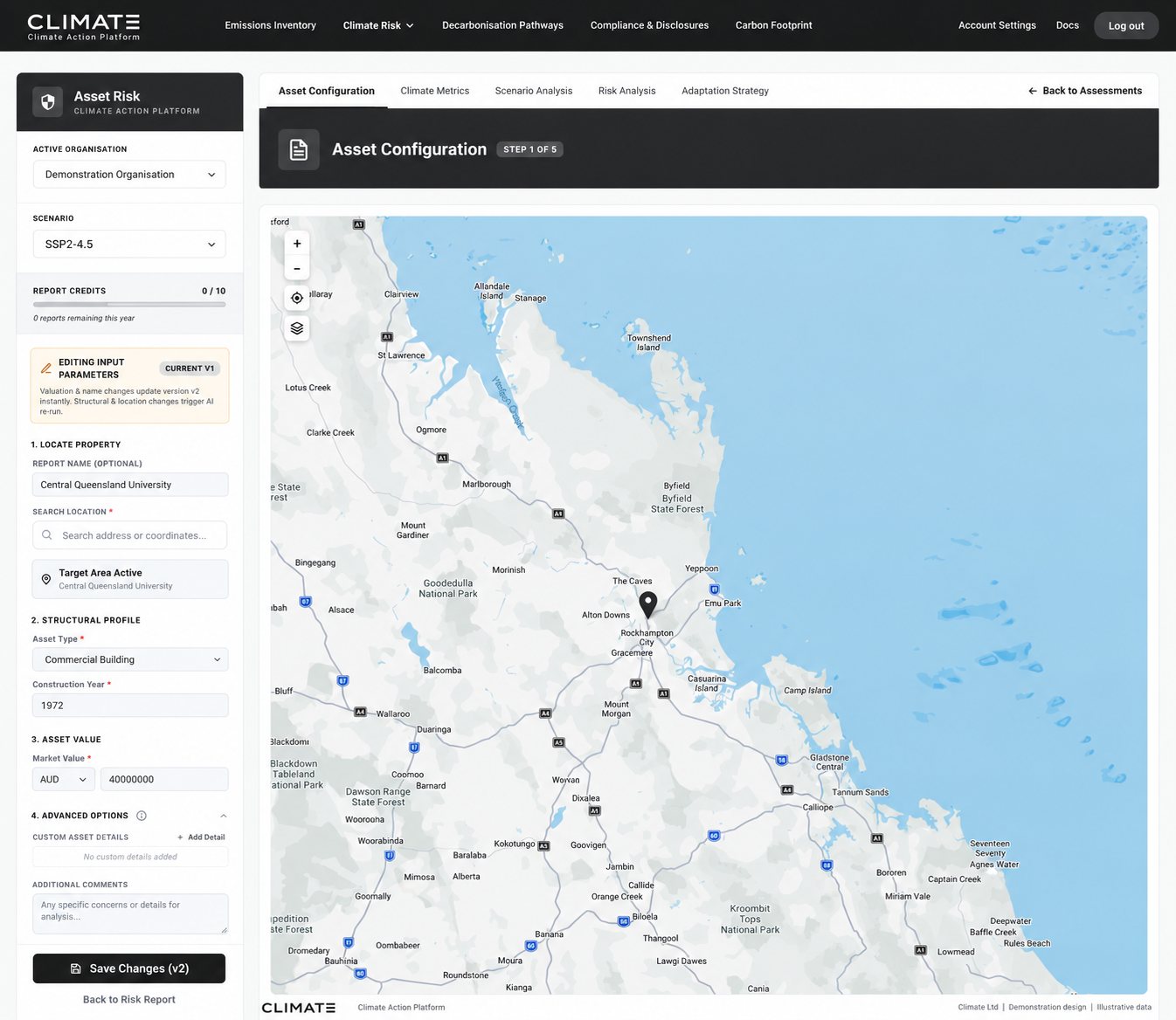
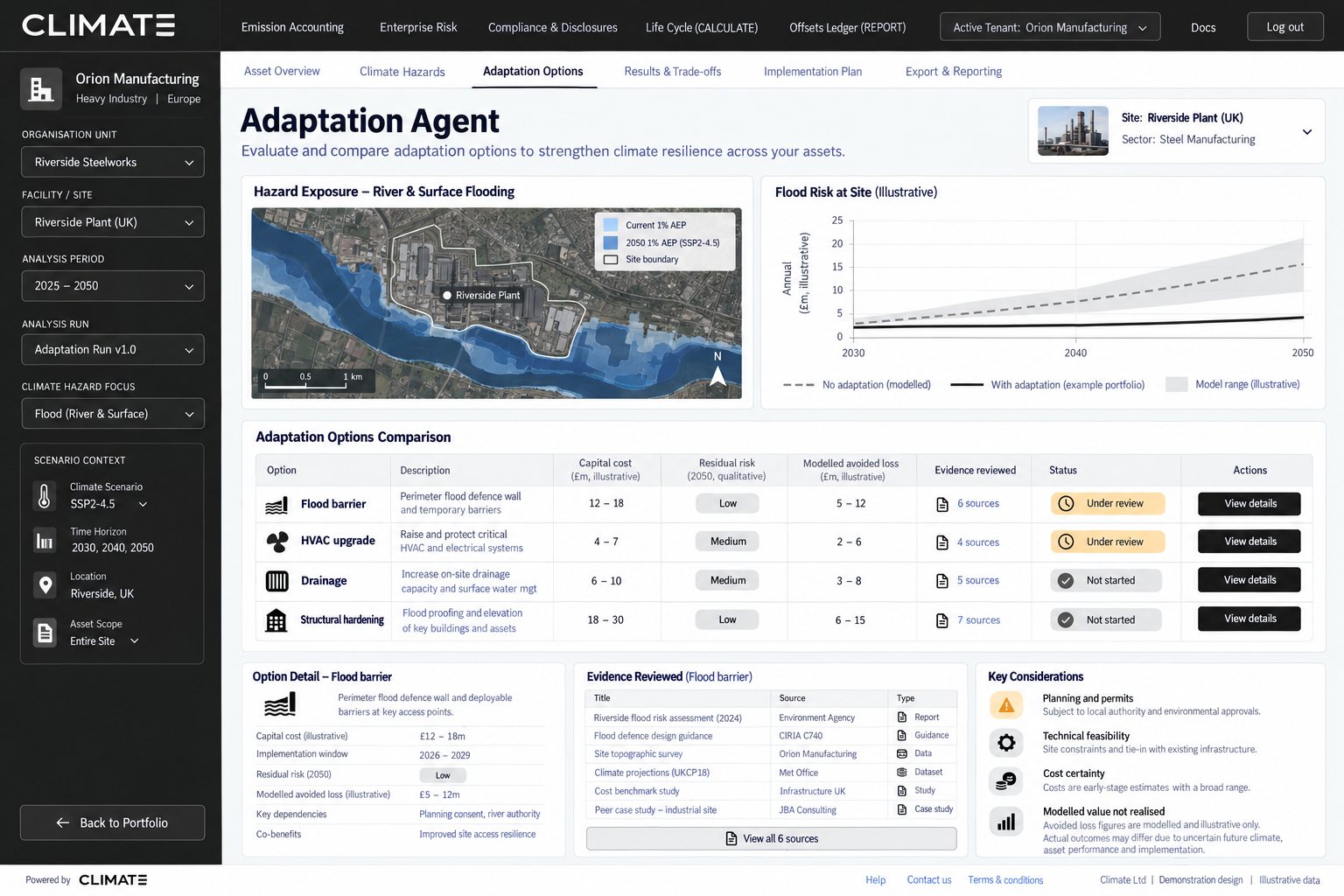
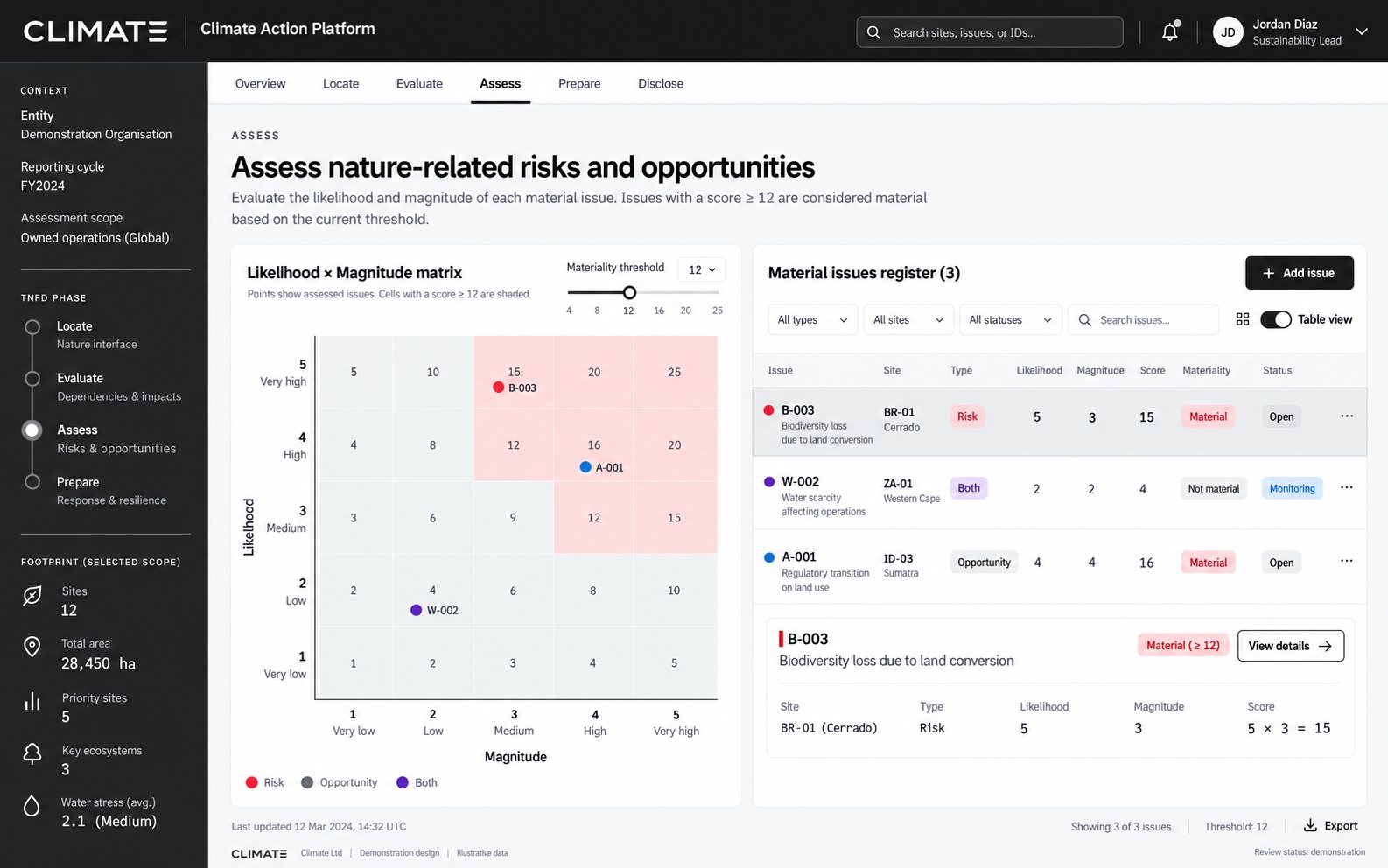
  • Physical hazard exposure — heat, flood, drought, wildfire, cyclone — modelled under multiple forward pathways
  • Every scenario translated into financial impact (revenue at risk, cost of carbon, capex exposure), not just an exposure score
  • Ranked resilience actions attached to each material exposure, so the output is something a team can act on
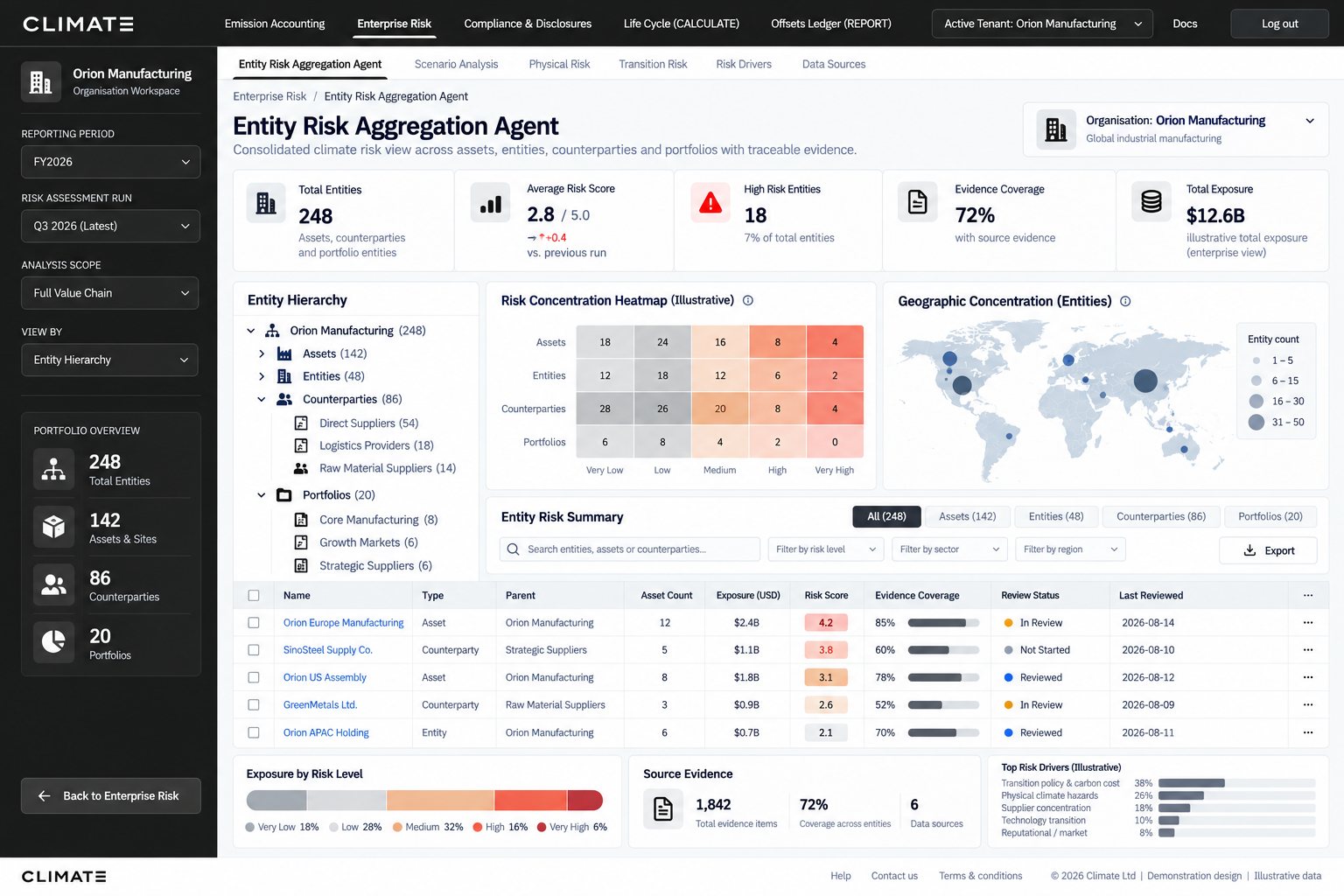
  • Entity-level aggregation rolls asset and organisation risk up to the counterparty or portfolio-position level, for lenders, insurers and asset owners stress-testing a whole book

Targets, MACC, adaptation & trajectory

A priced, sequenced decarbonisation and resilience pathway — checked against your commitment.

  • Set and segment targets by scope, year, business unit or emissions source
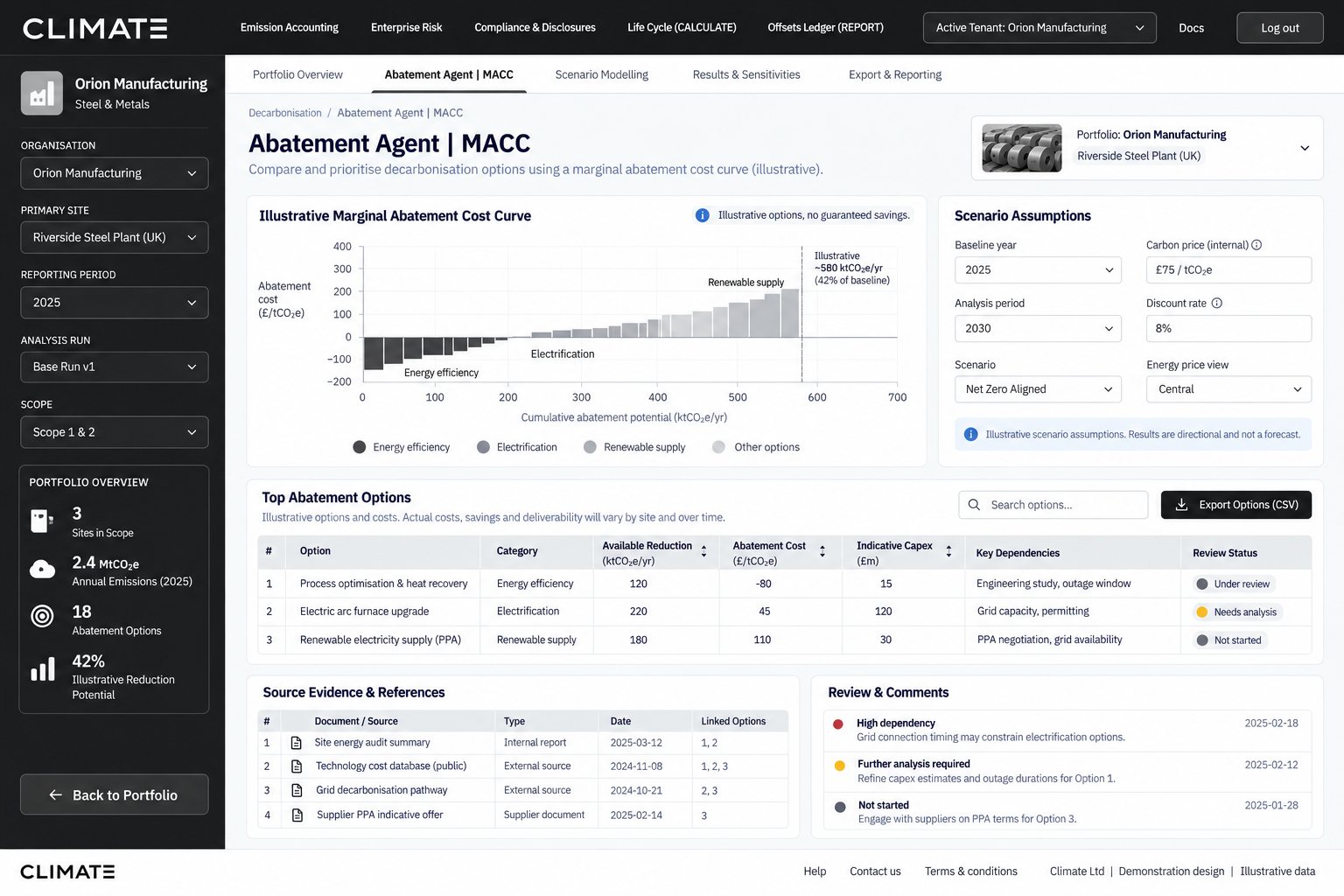
  • Marginal abatement cost curve (MACC) ranking every reduction lever by cost per tonne and available volume, refreshed as energy and carbon prices move
  • Adaptation ROI pricing for specific resilience measures — flood barriers, HVAC upgrades, structural hardening — against avoided-loss value, the same priced-lever logic applied to resilience instead of abatement
  • Target Alignment Check (TAC) overlays your SBTi or net-zero trajectory on the curve and flags where committed abatement falls short
  • Compare reduction and adaptation scenarios side by side to see which combination of levers actually closes the gap
04

Report, disclose & assure

Compliance-ready reporting

Disclosures generated from the live data model, not drafted from scratch.

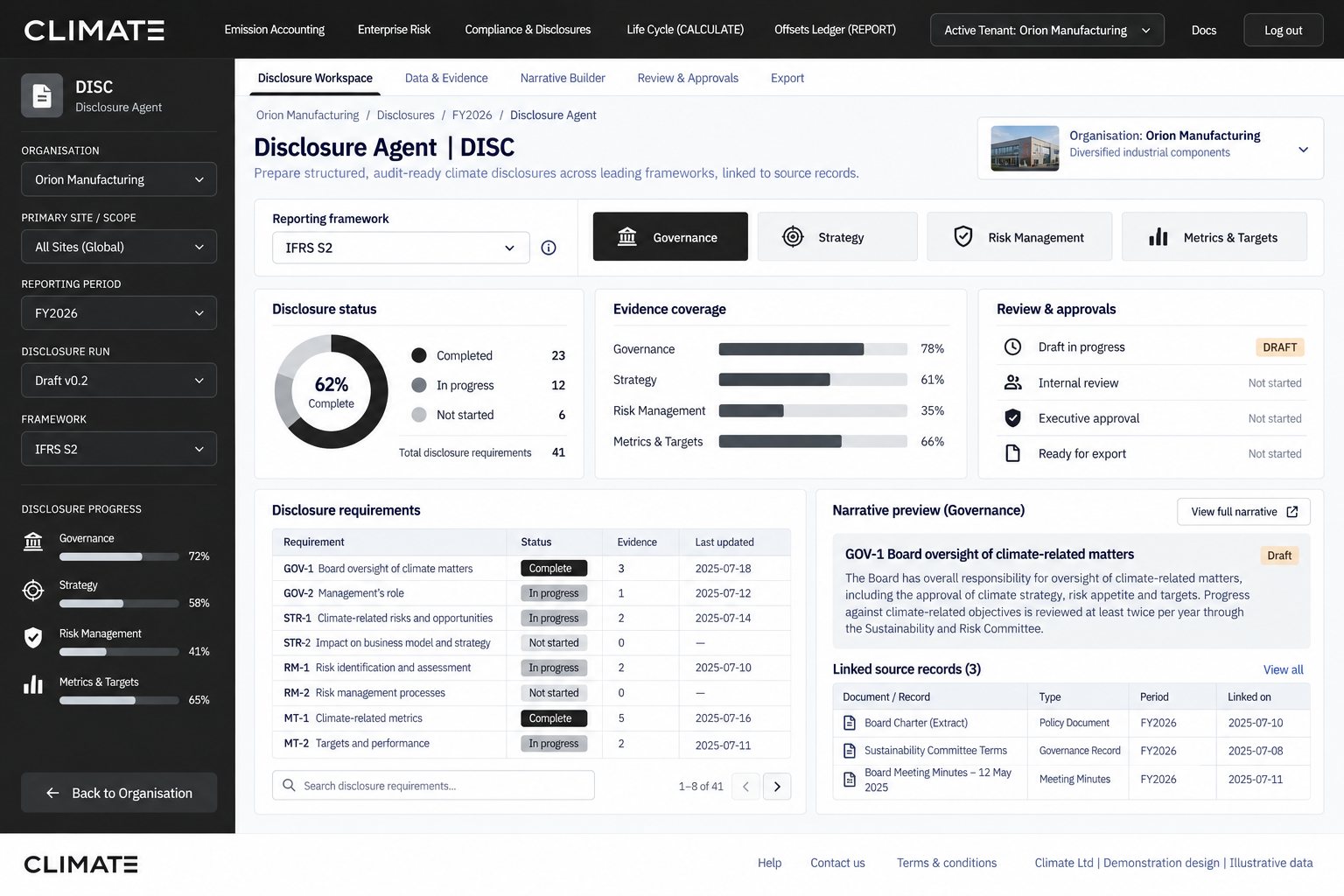
  • IFRS S2/ISSB, CSRD/ESRS, TCFD and CDP filings assembled from one underlying data model
  • Jurisdictional overlays — AASB S2, UK SRS, SEC Climate Rule and others — configured rather than rebuilt
  • Report by scope, entity, supplier or category, with full traceability back to source
  • Schedule recurring custom reports for the board, ESG committee or individual clients

Audit, assurance & offsets

Built to survive being checked, not just to look complete.

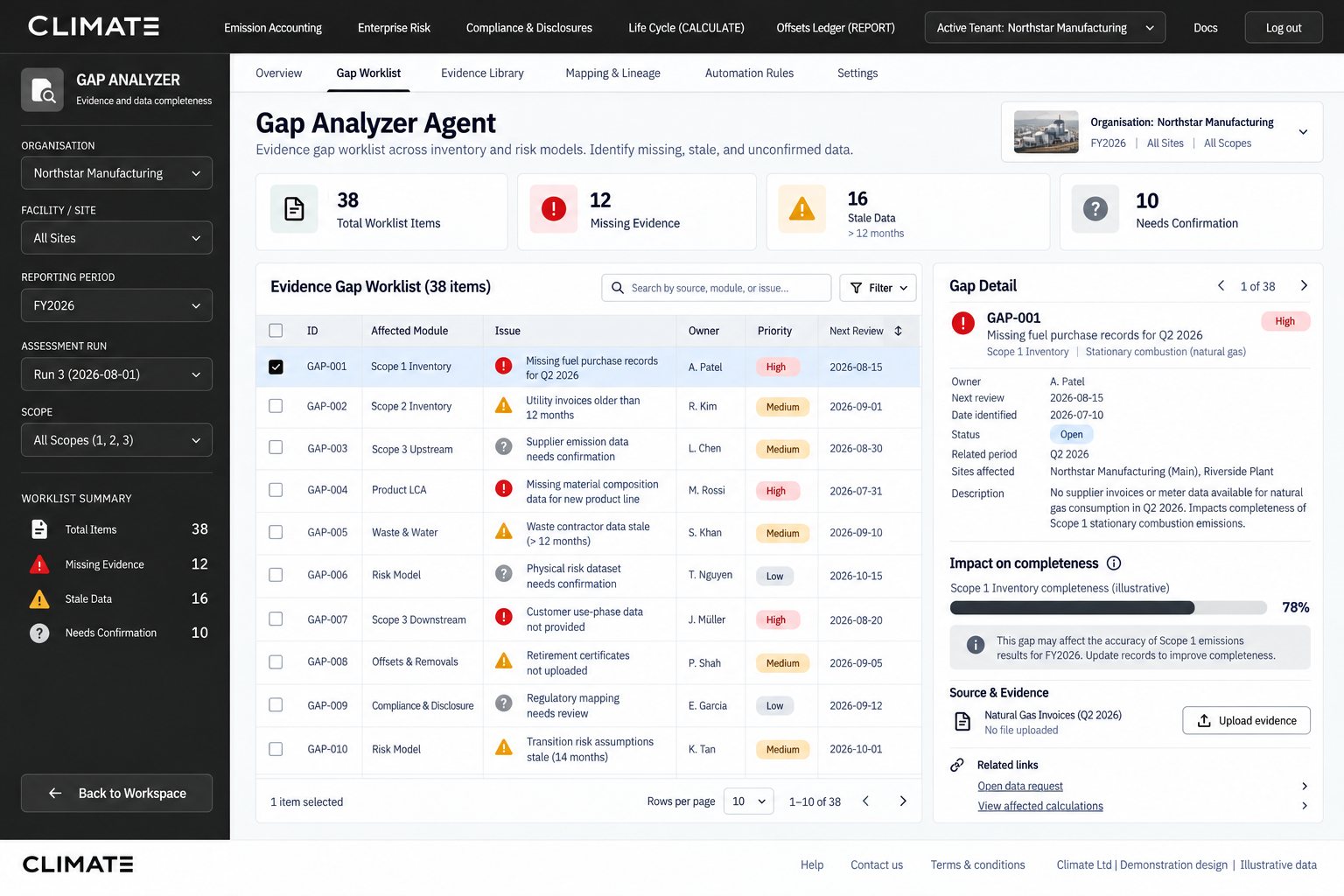
  • Exportable audit trails showing source data, formulas and every calculation step behind a figure
  • View and manage your own calculation rules rather than trusting a black box
  • Optional pre-assurance review to prepare a filing before it reaches your external auditor
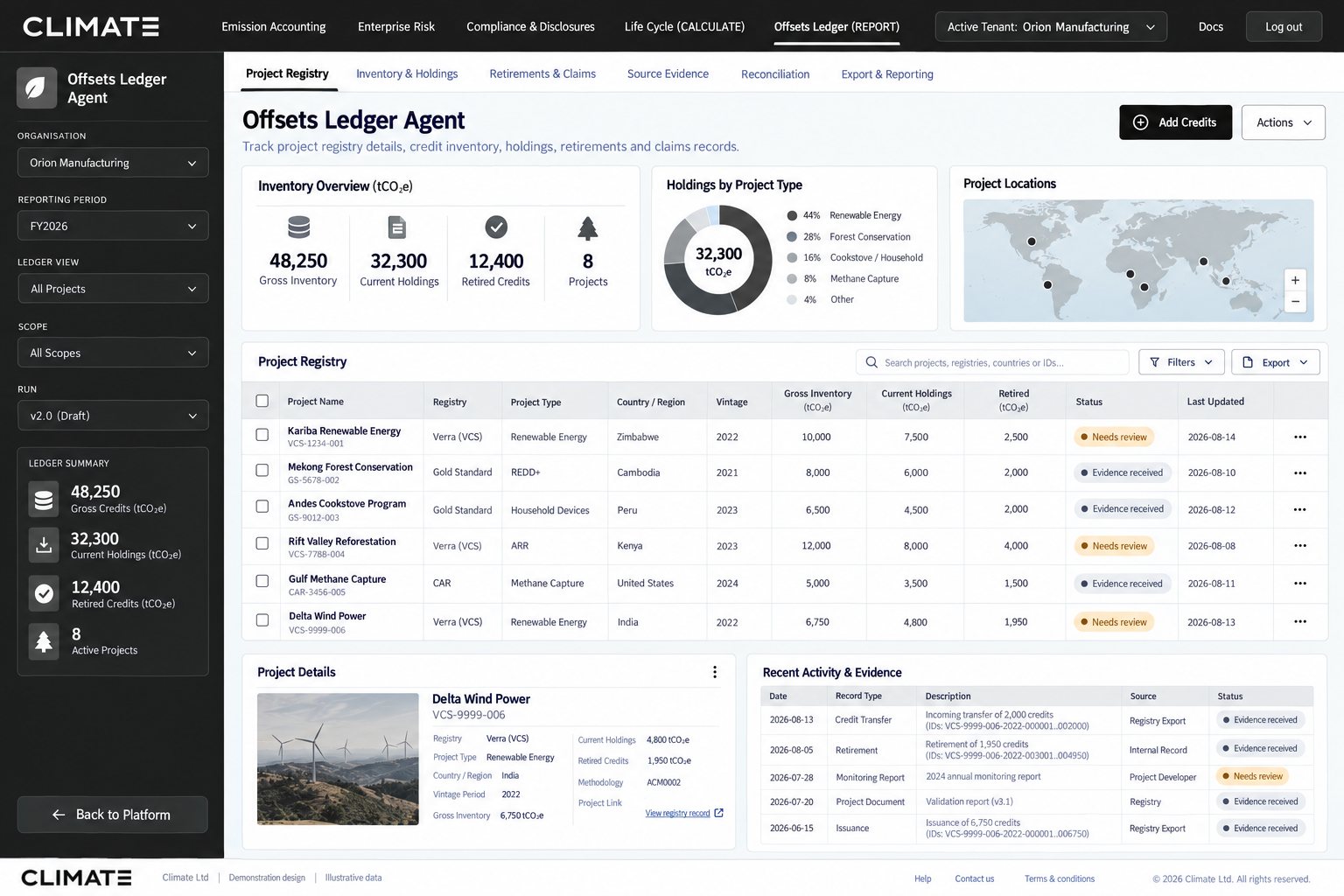
  • Offsets ledger: credit inventory, quality screening against project-level registries, retirement and claims tracking

Ask the ledger

A natural-language interface over your own climate data.

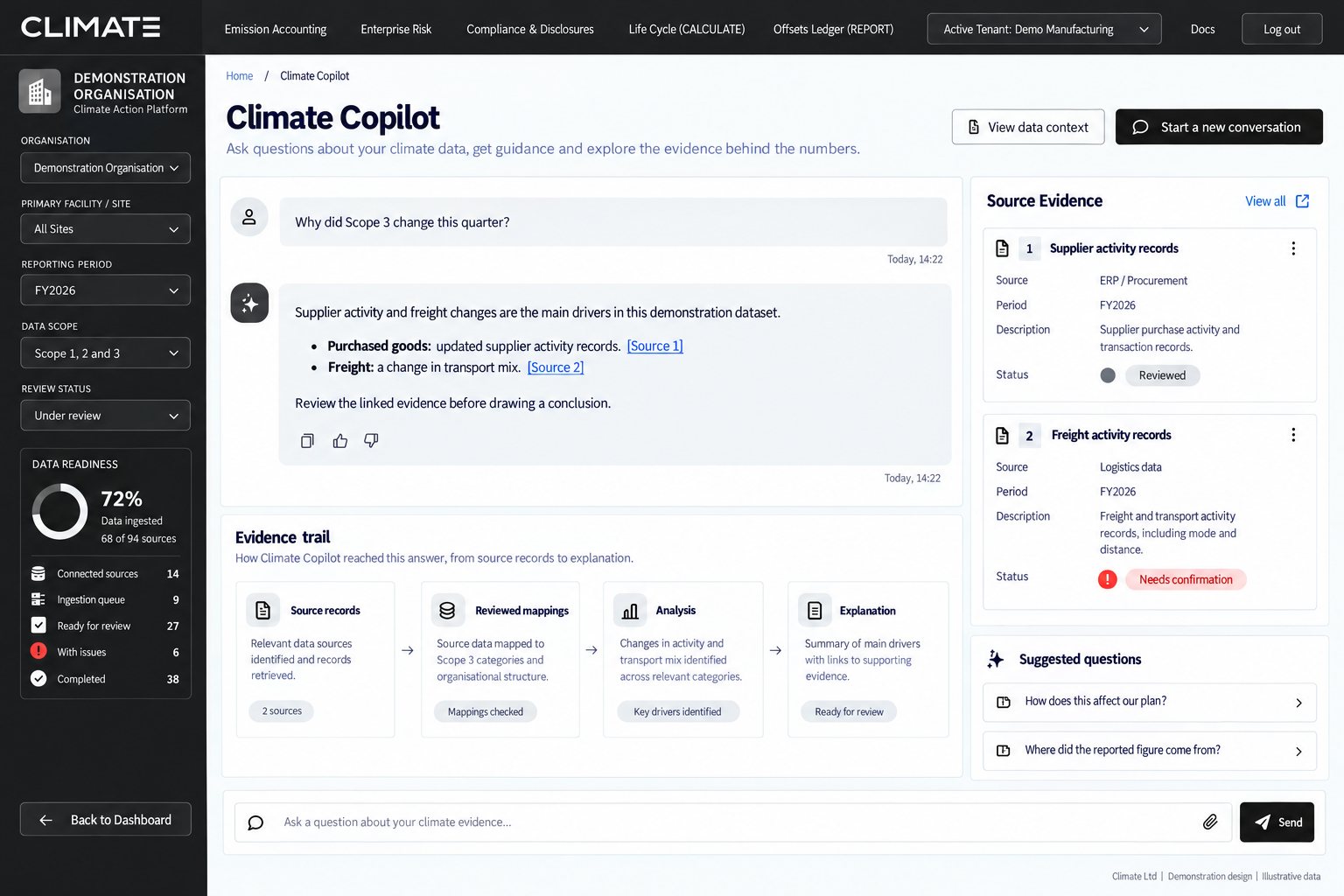
Climate Copilot sits over the same data spine as every agent on the platform. Ask it where a number in the filing came from, what's driving a scope 3 category up this quarter, or which resilience actions close the largest transition exposure — and get an answer with the source records cited, not a generic summary.

COPILOT · SAMPLE QUERY
?"Why did Scope 3 rise this quarter?"
2 new suppliers onboarded, category 1+4.1%
Freight mode shift, category 4+1.8%
Illustrative output — every answer cites its source records

See the platform on your own data.

Bring a spreadsheet, a supplier list, or last year's disclosure — we'll show you what the agents do with it.