
Specialists that work as one team.
Each agent owns a defined climate job and reads or writes to the same governed data spine. Agents propose; authorised people confirm.
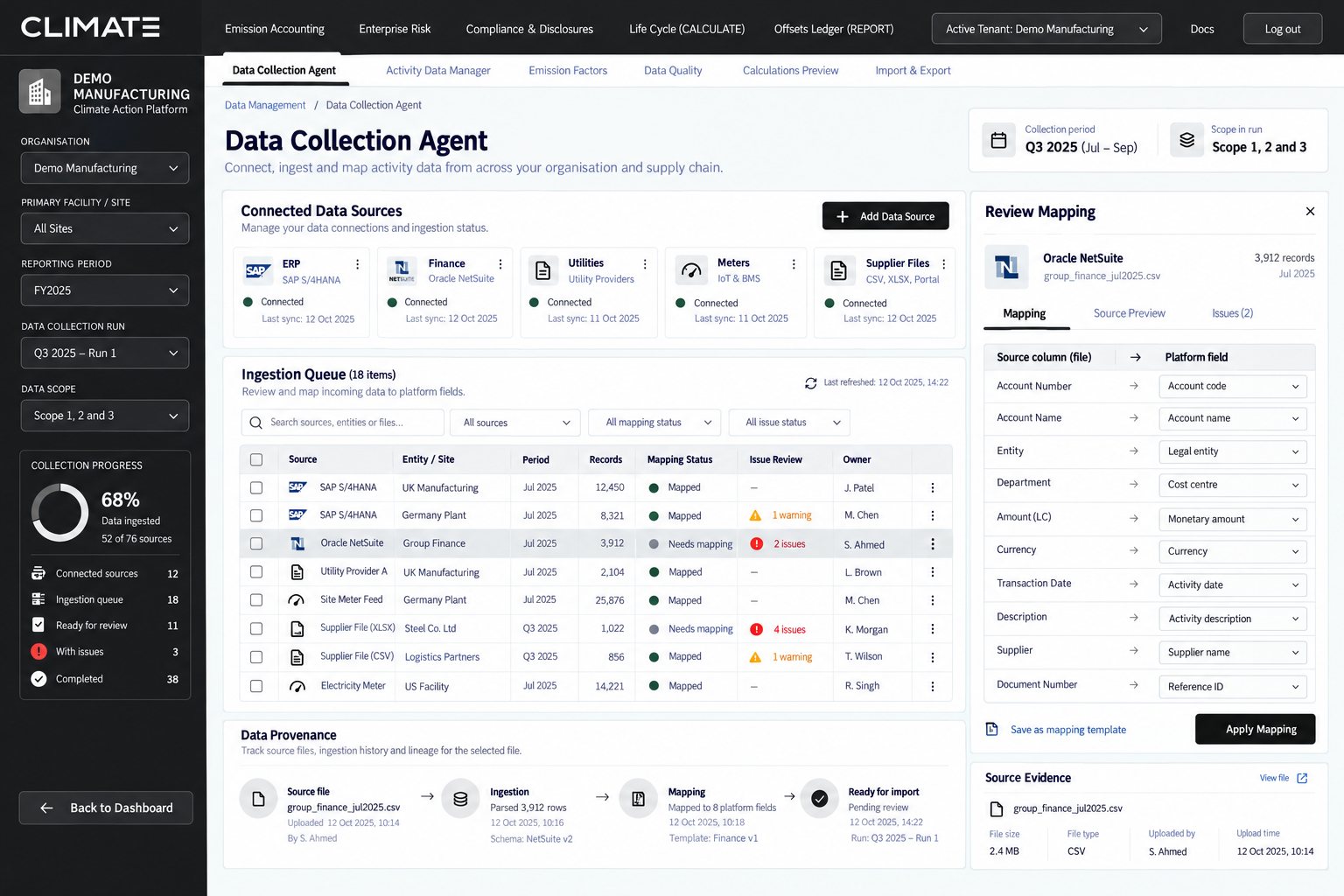
Data Collection: Connect the records once
ERP, finance, utilities, spend, meters, files and asset registers feed a common evidence base. Review imports and confirm mappings before records become inputs to downstream calculations.
Inputs
Spreadsheets, PDFs, scanned records and connected enterprise systems; entity, asset, reporting period and activity identifiers.
How it works
Import or connect records, map columns and units, resolve flagged issues, then confirm the accepted data. API access supports teams that push records from existing systems.
Simplifies the work
A reviewed record can support the inventory, risk analysis and disclosure without repeated re-entry. Portfolio onboarding brings multiple entities into a consistent structure.
Outputs
Mapped activity records, source provenance and a reviewed input set for other agents.
Robustness in practice
Check boundary, units, period and completeness. Resolve duplicates and reconcile key totals with the originating system. Agree connector scope and refresh frequency during implementation.

Supply Chain: Improve evidence across the value chain
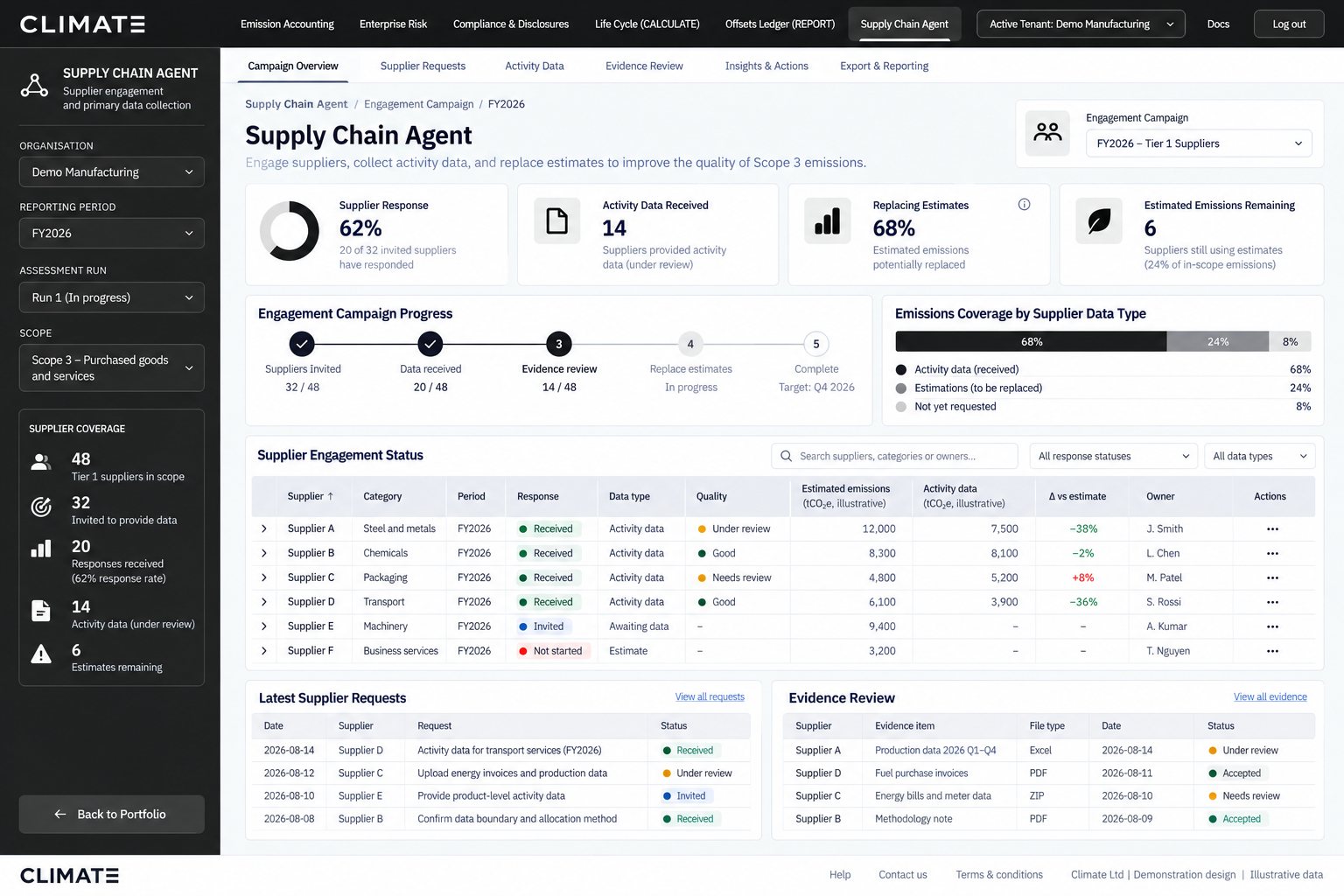
Supplier engagement becomes part of the inventory workflow. As primary data improves, teams can refine estimates and explain what changed instead of running a separate email exercise each reporting cycle.
Inputs
Supplier and counterparty lists, purchase activity, spend estimates and available supplier-specific evidence.
How it works
Send plain-language requests, track completion and data quality by campaign, then upload and reconcile responses into the inventory. Limited supplier access can support direct contributions.
Simplifies the work
Engagement and calculation share the same evidence. Priority suppliers can be targeted for better activity data, reducing reliance on broad estimates where suitable information becomes available.
Outputs
Reconciled supplier activity, campaign status and evidence to inform Scope 3 estimates and procurement discussions.
Robustness in practice
Review supplier boundaries, coverage, allocation and reporting periods. Separate primary evidence from estimates; retain the basis for changes when improving the inventory.

Gap Analyzer: Make missing evidence visible
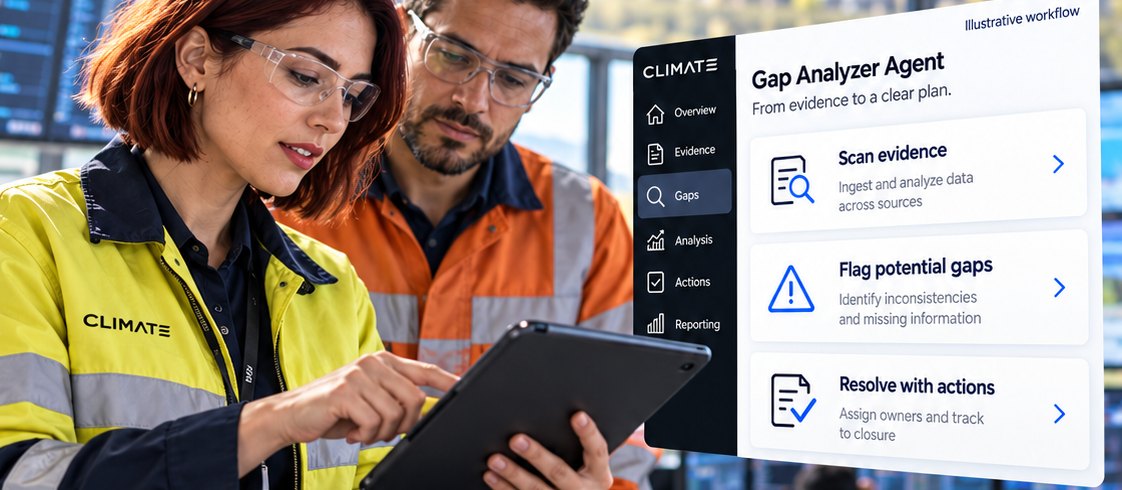
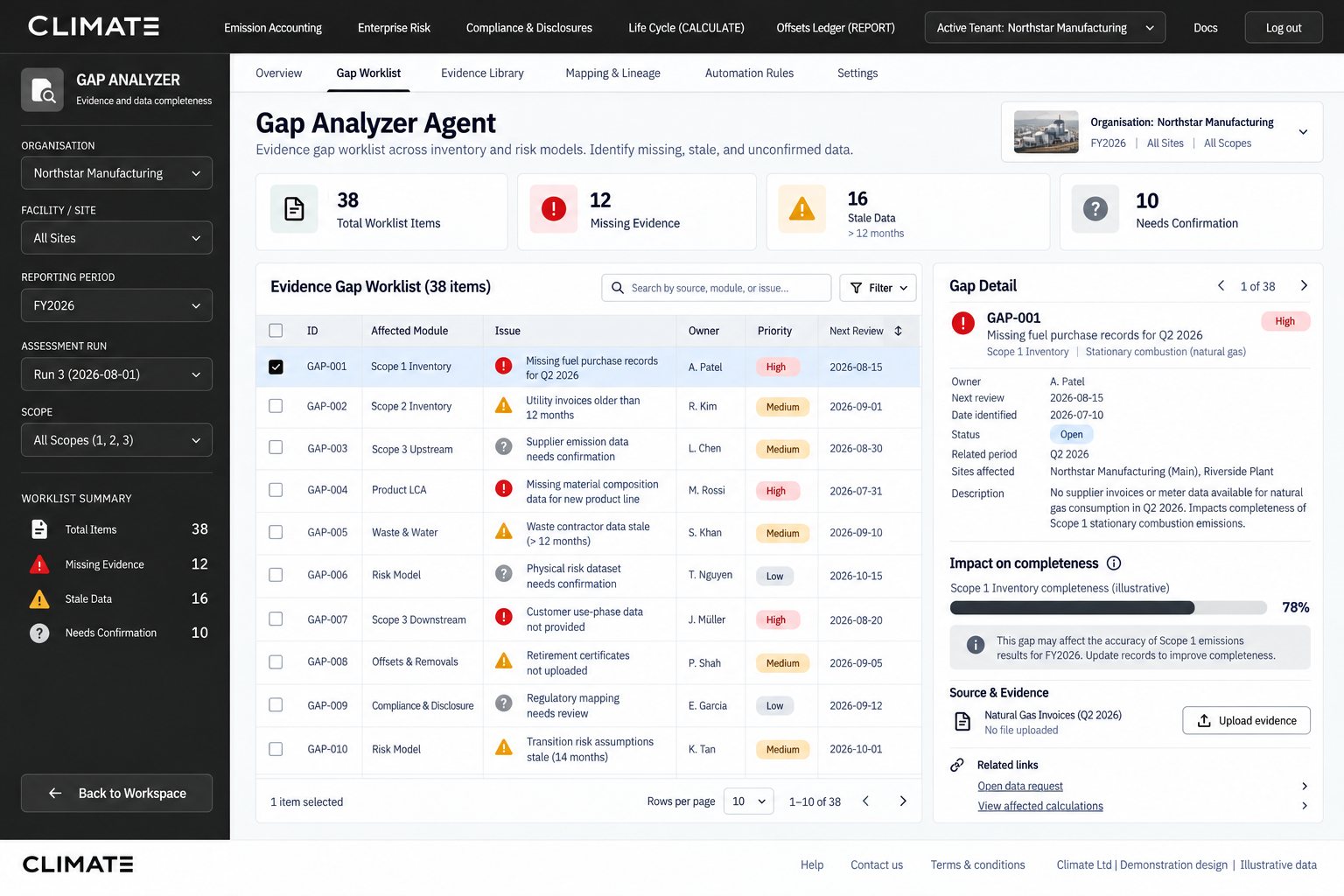
A connected workflow is only useful when teams know where its evidence is incomplete. The Gap Analyzer scans inventory and risk inputs for missing or stale records so owners can address them before reporting.
Inputs
Inventory records, risk-model inputs, available dates and the evidence requirements agreed for the engagement.
How it works
Identify missing or stale inputs, flag affected areas and route the issues into the team’s review process. Recheck the evidence as new information arrives.
Simplifies the work
Concentrates the collection effort on unresolved inputs rather than repeatedly reviewing the entire dataset. Finance, operations and advisers work from a shared view of evidence needs.
Outputs
A clearer evidence-gap view to support collection priorities and reporting readiness discussions.
Robustness in practice
Assign owners and review the significance of each gap. A complete-looking dataset can still contain errors: combine gap checks with reconciliation and expert review.
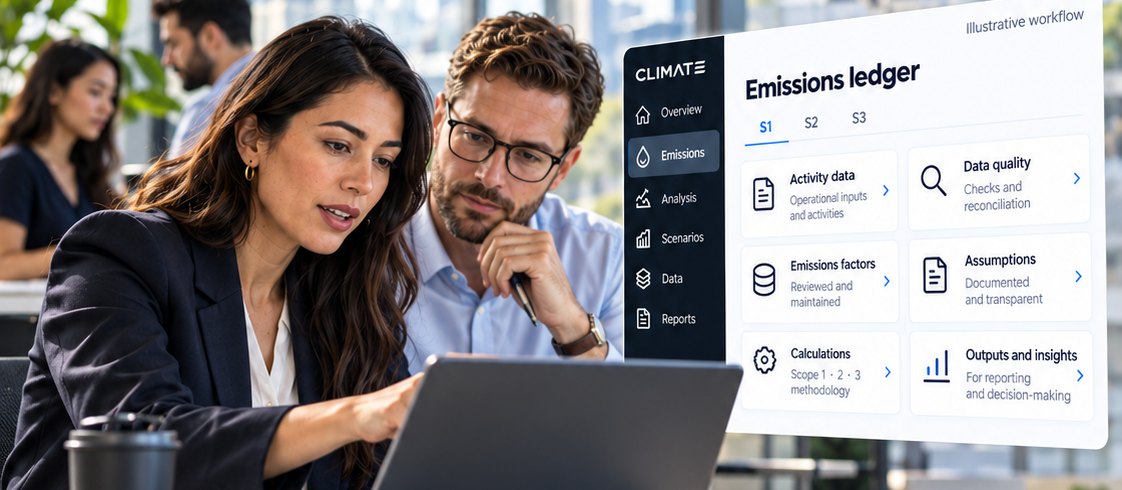
Emissions Ledger: Maintain one emissions inventory
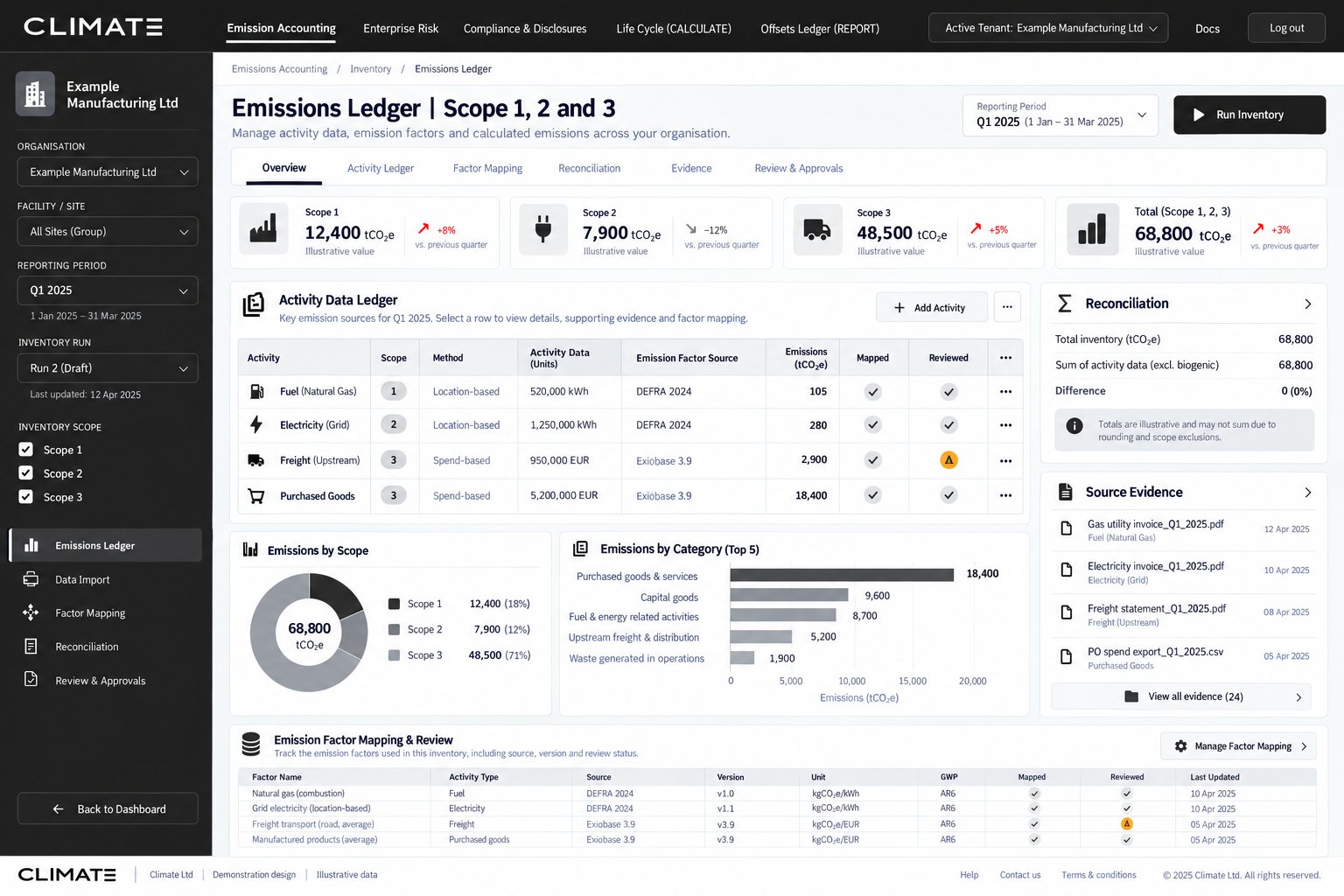
A common ledger connects activity records with calculation methods and emissions factors. It supports corporate inventory preparation while retaining the evidence needed to understand and review the numbers.
Inputs
Fuel, electricity, purchased goods, transport, spend and supplier records, with relevant emissions factors and organisational boundaries.
How it works
Apply spend-based, activity-based or supplier-specific methods. Review and confirm activity-to-factor mappings; reconcile the ledger as accepted records arrive. Custom or licensed factors can be used where appropriate.
Simplifies the work
Reuses reviewed mappings across periods and supplies a consistent inventory to planning and disclosure. Teams focus on changes and exceptions rather than reconstructing the calculation chain.
Outputs
Scope 1, 2 and 3 results by relevant entity, category or period, with underlying records available for review.
Robustness in practice
Apply GHG Protocol boundaries and methods. Retain factor provenance, units and assumptions. Review uncertainty, exclusions and recalculation needs; gross emissions remain distinct from offsets.
Life Cycle: Connect product footprints to activity data
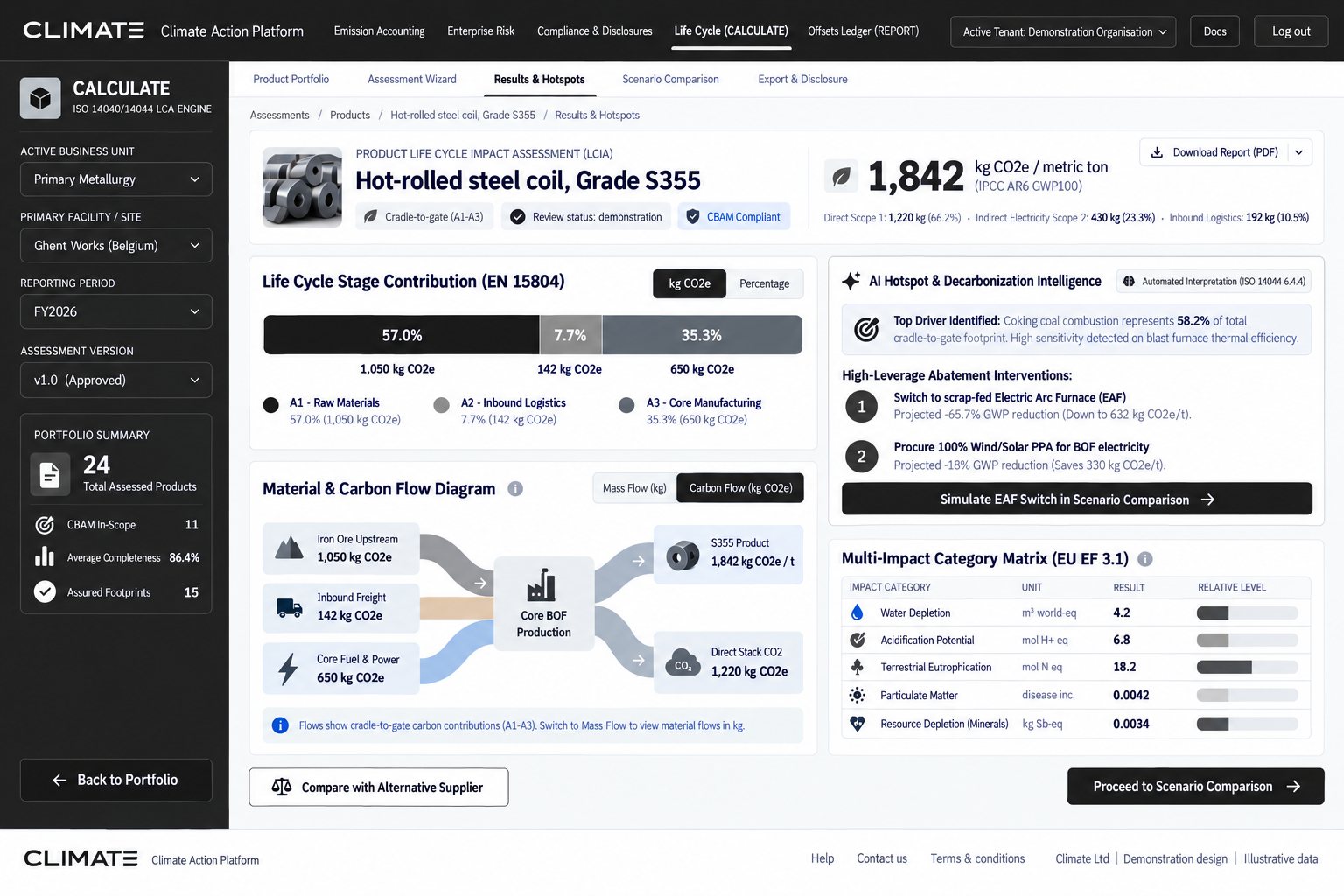
Product and material footprints can use the activity evidence already maintained for the corporate inventory. Shared inputs reduce duplicate data handling while preserving the different boundaries required for life cycle work.
Inputs
Product or material activity, bill-of-material information, energy and process inputs, supplier evidence and appropriate factors.
How it works
Define the goal, functional unit and cradle-to-gate or cradle-to-grave boundary. Apply an ISO 14040/14044-aligned approach using the shared activity data and factors.
Simplifies the work
Allows product hotspots and corporate inventory findings to be discussed together. Results can inform design, procurement and relevant Scope 3 analysis without a disconnected collection process.
Outputs
Product and material footprint results, hotspot analysis and a documented basis for comparing options.
Robustness in practice
Review allocation, completeness, comparability and data quality with a qualified practitioner. For CBAM-related work, assess the specific embedded-emissions rules separately; an LCA is not automatically a compliant CBAM calculation.

Offsets Ledger: Keep credits and claims traceable
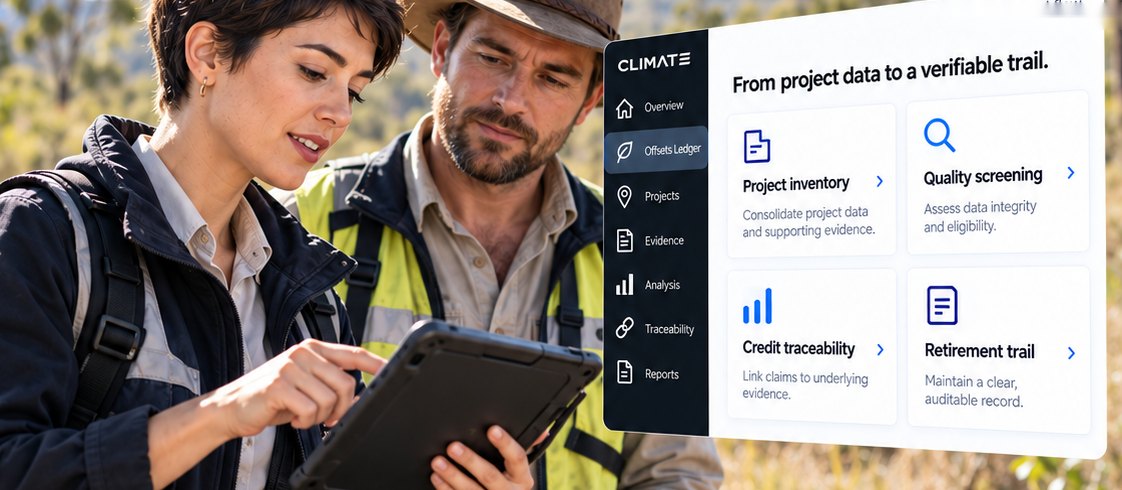
Credit records sit alongside the climate programme while remaining distinct from the gross inventory. The Offsets Ledger supports credit inventory, project screening, retirement records and the evidence behind a claim.
Inputs
Credit holdings, project and registry identifiers, supporting quality information and retirement documentation.
How it works
Maintain the credit inventory, screen project-level registry information and record retirement and claims activity with an audit trail.
Simplifies the work
Brings supporting documents into a structured review instead of leaving holdings, retirement certificates and public claims in separate files.
Outputs
A credit and retirement record that supports internal review and transparent communication.
Robustness in practice
Check ownership, unique identifiers, vintage, retirement status and the proposed claim. Assess quality risks and applicable claims guidance. Credit tracking does not establish additionality or guarantee integrity on its own.
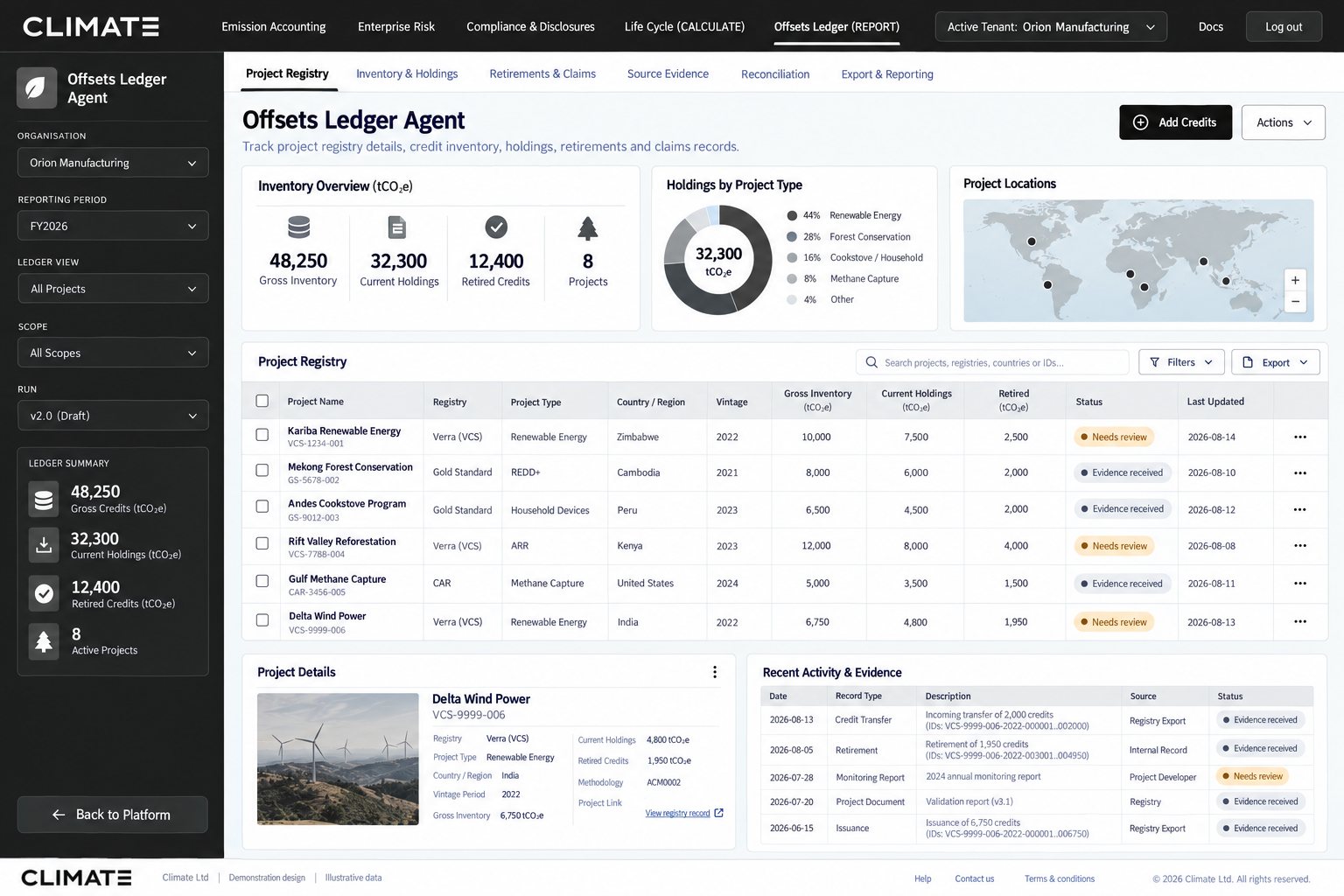
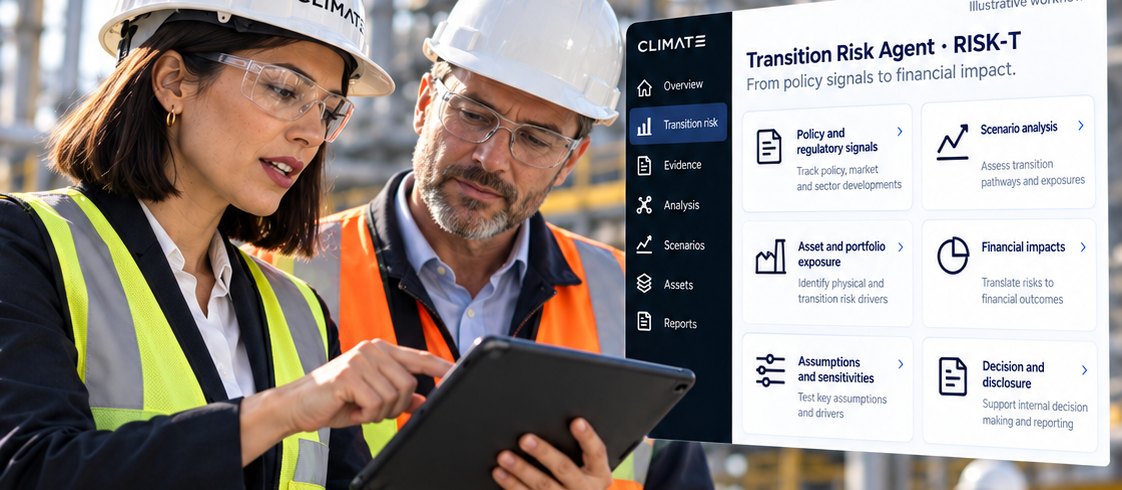
Transition Risk: Translate transition exposure into decisions
Policy, carbon pricing, technology and demand can change a business’s costs and opportunities. RISK-T models these changes under scenarios and connects the findings with financial implications and response options.
Inputs
Inventory and business activity, energy and carbon-price assumptions, sector context, technology pathways and demand sensitivities.
How it works
Apply selected transition scenarios to the organisation, its assets and supply chain. Examine material exposures and translate the modelled changes into financial effects and resilience actions.
Simplifies the work
Connects the risk discussion with investment planning and disclosure. Teams can compare which assumptions drive an outcome rather than working from an isolated exposure rating.
Outputs
Scenario-dependent exposures, financial interpretation and a basis for prioritising further analysis or action.
Robustness in practice
Document scenario choice, timing, sensitivities and transmission assumptions. Scenarios explore plausible conditions; they are not forecasts. Avoid treating modelled effects as certain losses.
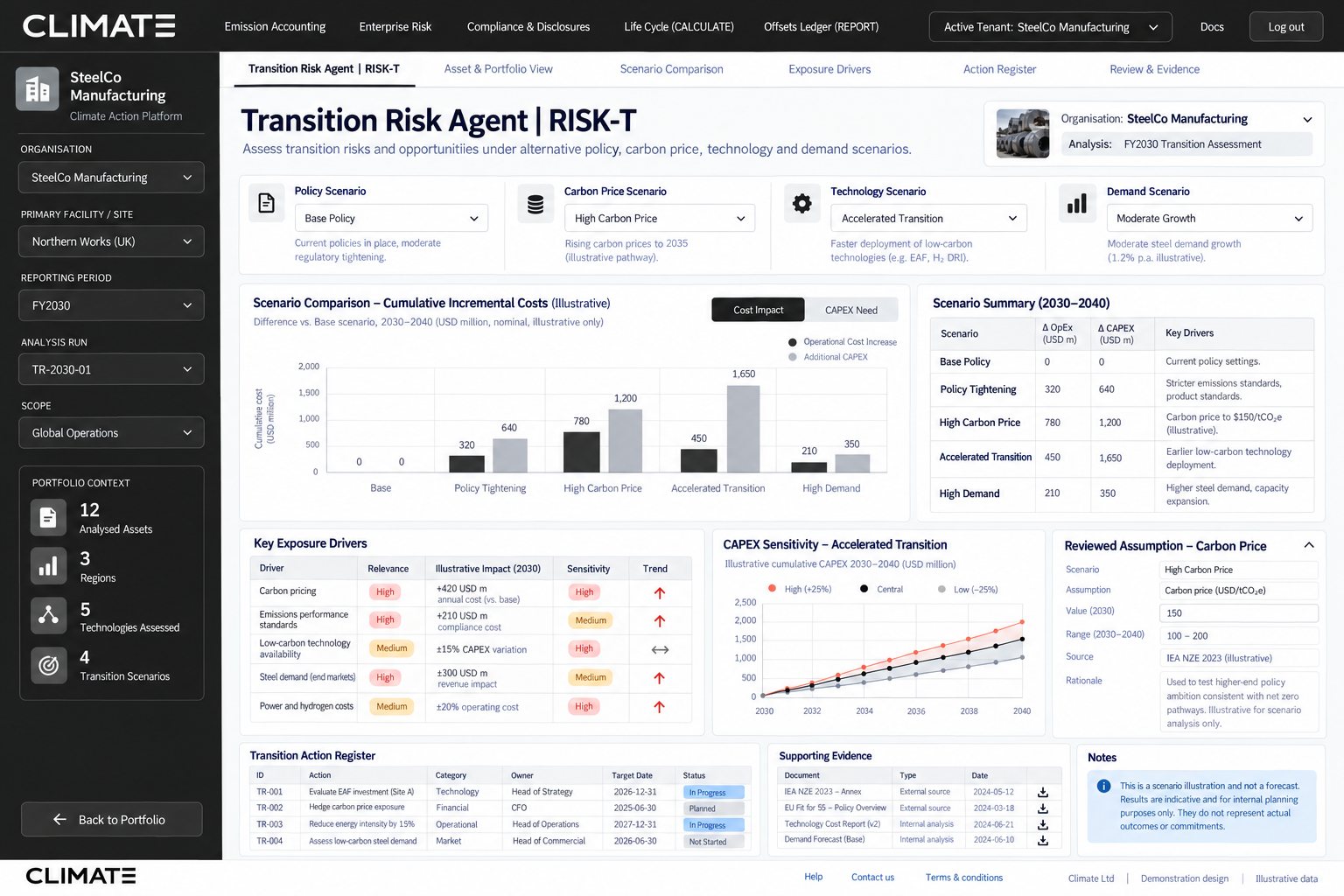
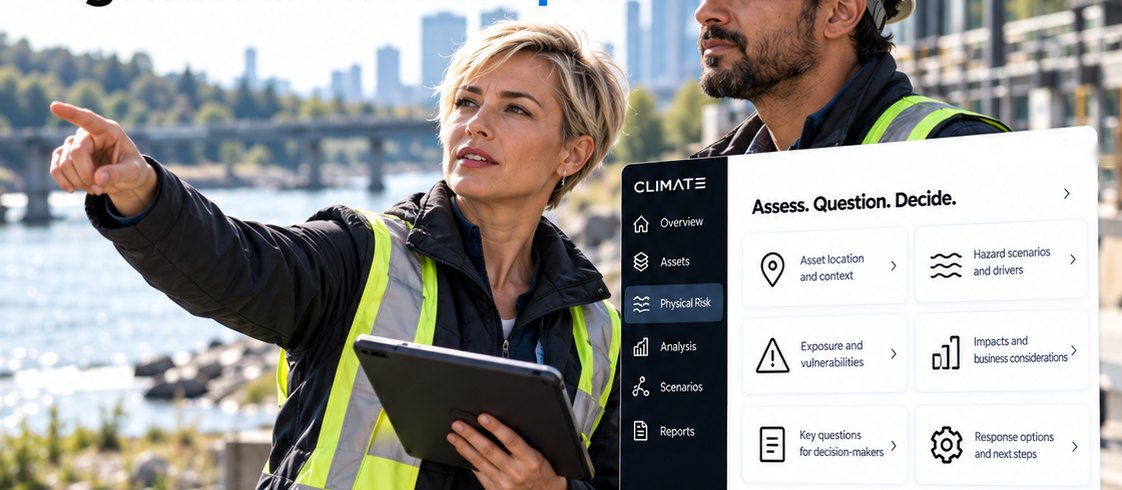
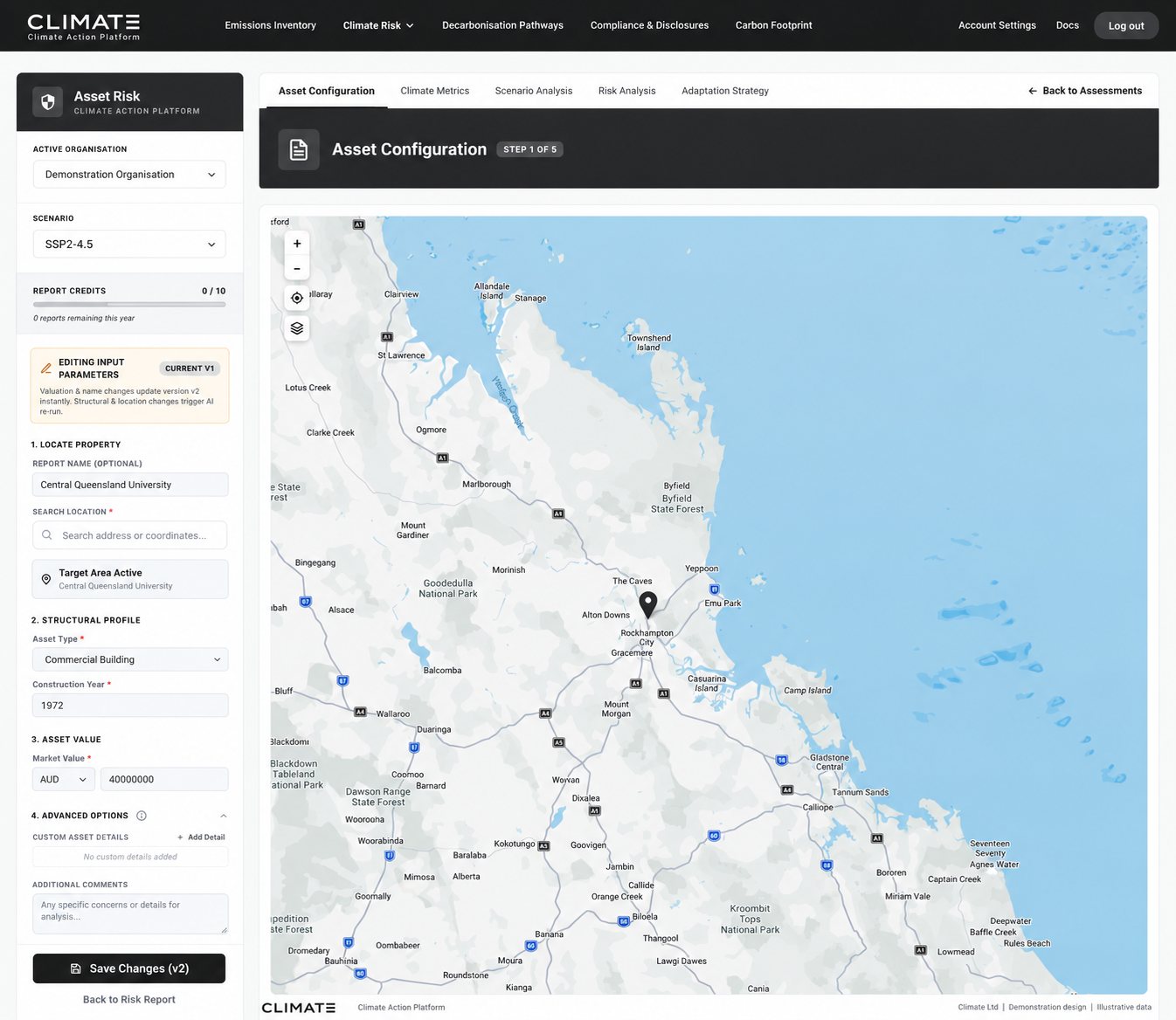
Physical Risk: Connect local hazards with asset decisions
Physical climate analysis considers how hazards intersect with places and operations. The platform describes downscaled climate modelling across forward pathways, with outputs available to financial and adaptation workflows.
Inputs
Asset locations and attributes, operating context and hazard data for heat, flood, drought, wildfire and cyclone.
How it works
Assess exposure under selected pathways and time horizons. Bring relevant findings into financial interpretation and the assessment of practical resilience measures.
Simplifies the work
Connects asset-level analysis with the wider portfolio and gives operations, risk and finance a common basis for discussing priorities.
Outputs
Location-specific hazard and exposure information, with pathways and assumptions that inform subsequent risk assessment.
Robustness in practice
Review geocoding, model coverage and resolution. Hazard exposure is not the same as damage or financial loss; vulnerability and operating assumptions matter. Downscaling can inherit source-model bias and requires validation appropriate to the use.
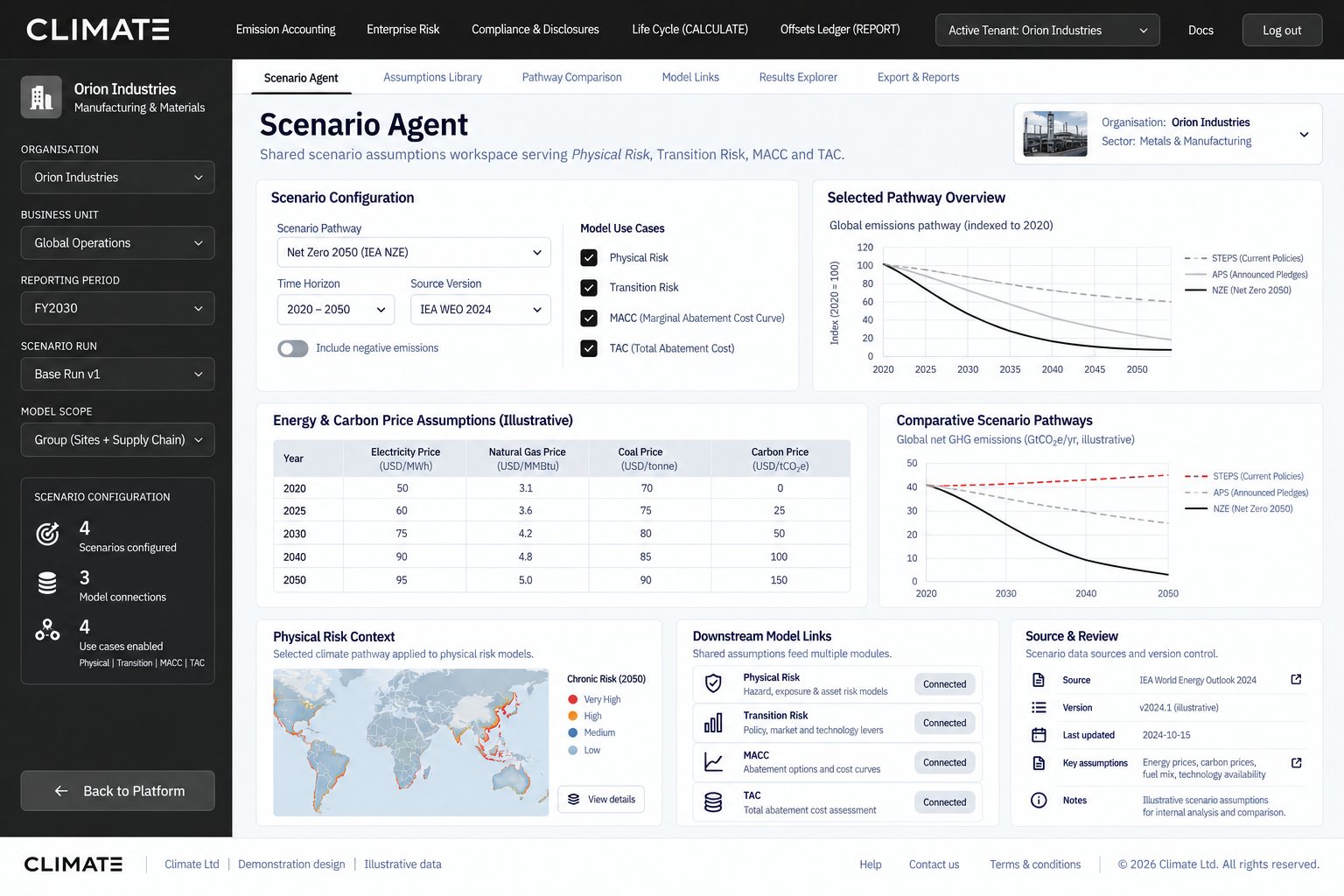
Scenario: Keep assumptions consistent across models
A risk study and an investment plan can be difficult to compare when they use different futures. The Scenario Agent maintains the common assumptions used by risk and decarbonisation workflows.
Inputs
Recognised climate and transition scenario frameworks, selected pathways, time horizons and business-specific sensitivities.
How it works
Build and maintain a shared scenario basis for RISK-T, RISK-P, MACC and TAC. Use that basis to compare consequences and choices across the connected workflow.
Simplifies the work
Makes assumptions easier to inspect across workstreams. A change to the scenario basis can be considered consistently instead of being reinterpreted independently by each team.
Outputs
A common set of scenario assumptions and comparable analytical runs to support management discussion.
Robustness in practice
Retain the scenario source, version, horizon and adaptation assumptions. Test sensitivities and explain uncertainty. A scenario label alone does not establish alignment between physical and transition pathways.

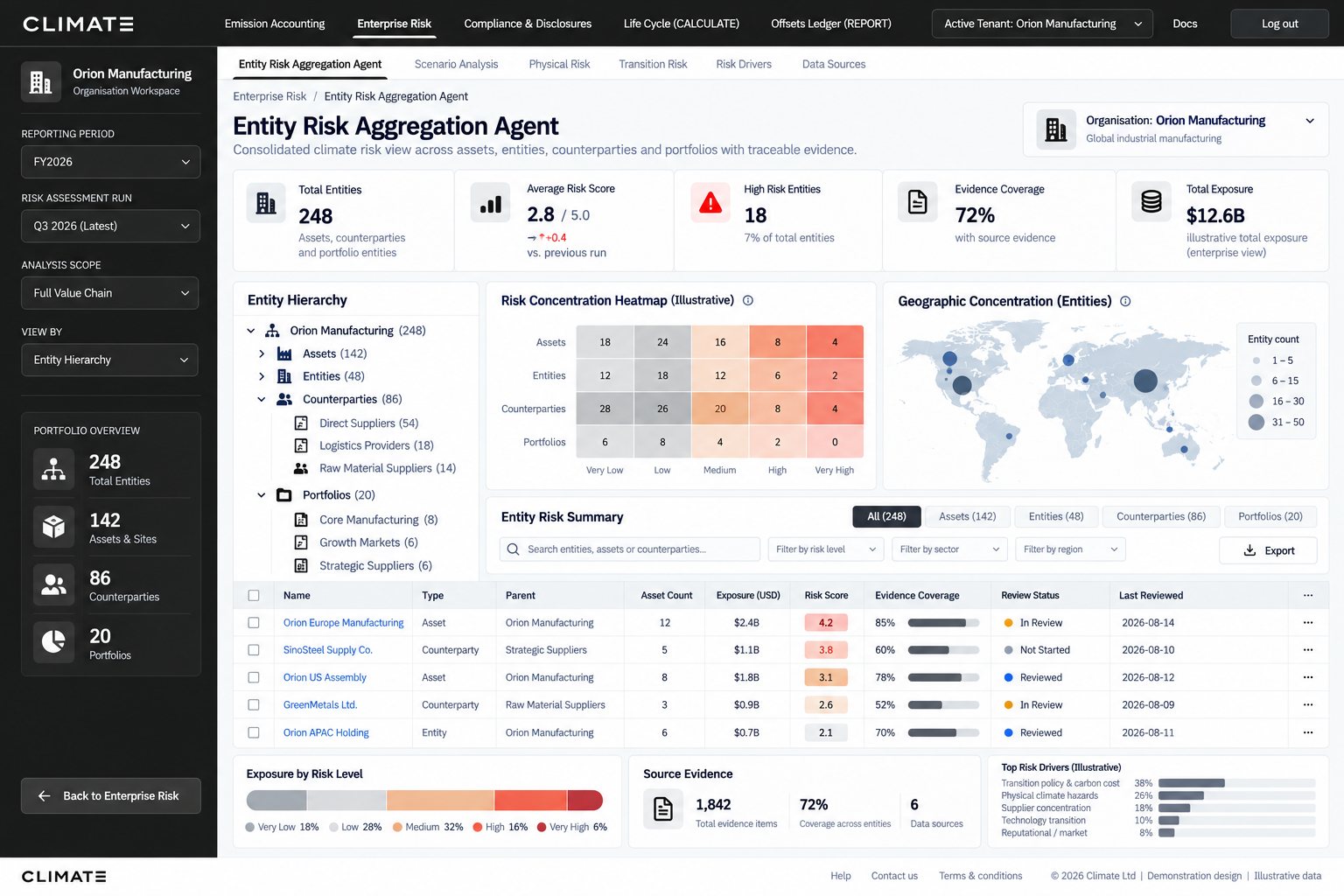
Entity Risk Aggregation: See exposure across the whole portfolio
Asset-level findings need an organised route into entity and portfolio discussions. This agent aggregates relevant risk information so lenders, insurers, investors and asset owners can examine concentrations across their book.
Inputs
Asset and organisation risk outputs, ownership or exposure relationships and a defined counterparty or portfolio hierarchy.
How it works
Roll relevant findings from assets to organisations, counterparties or portfolio segments. Preserve the ability to investigate the underlying exposures.
Simplifies the work
Reduces the need to manually combine separate asset reports. Common aggregation provides a basis for prioritising engagement, resilience review and capital questions.
Outputs
Entity and portfolio views of exposure, concentrations and contributing records.
Robustness in practice
Review ownership, weighting, overlap and missing coverage. Do not simply add incompatible risk measures or assume diversification. Make correlation, aggregation limits and coverage visible.

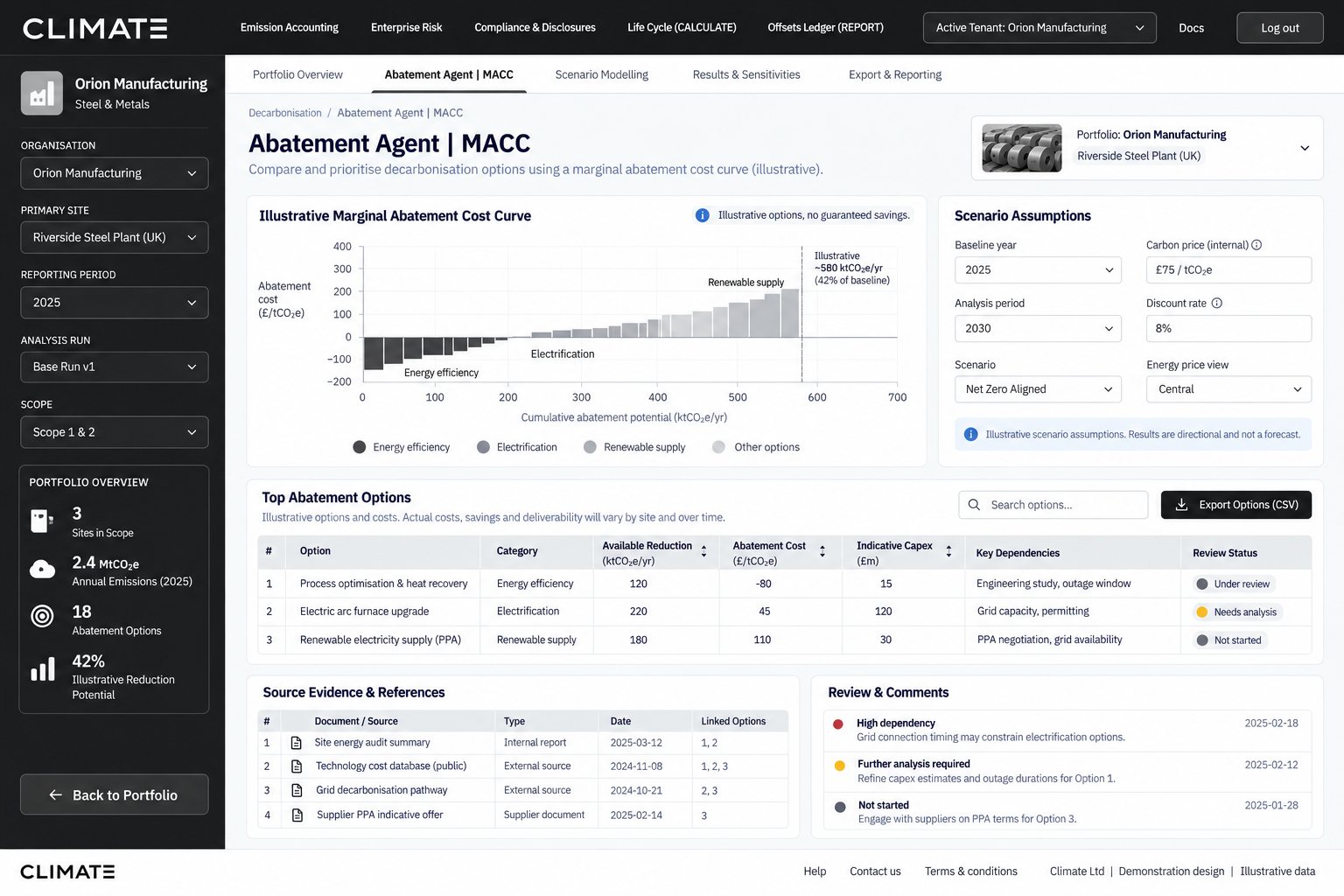
Abatement: Compare the economics of reduction options
The Abatement Agent brings the inventory into a practical investment discussion. Marginal abatement cost curves help teams compare reduction potential and cost while considering the operating context of each option.
Inputs
Emissions sources, feasible reduction measures, capital and operating costs, useful lives, energy prices and carbon-price assumptions.
How it works
Estimate available reduction volume and cost per tonne. Refresh the comparison as relevant prices change, then use it alongside feasibility and sequencing considerations.
Simplifies the work
Connects an emissions hotspot with a priced response. The same reduction options can inform target assessment, financial interpretation and the disclosure narrative.
Outputs
A marginal abatement cost curve and a transparent basis for comparing potential reduction measures.
Robustness in practice
Review baseline, discounting, timing and interactions between measures. Avoid double counting reductions. A MACC is one decision input, not a complete project business case or a guaranteed delivery outcome.

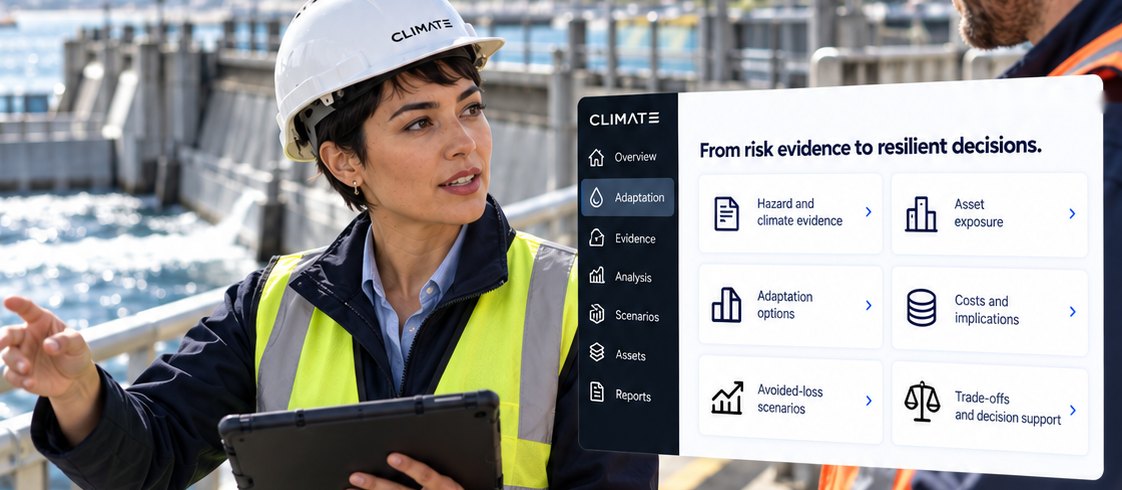
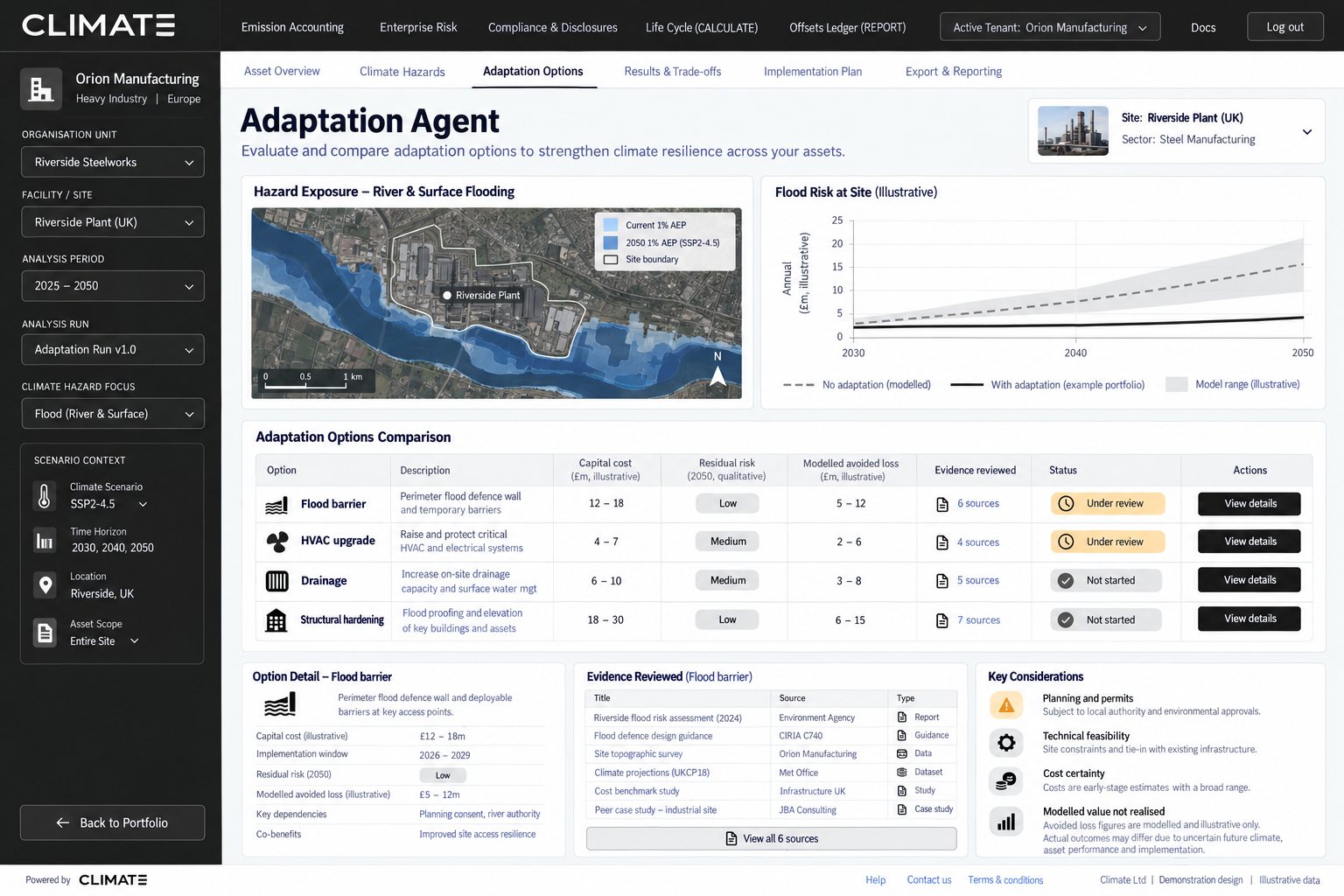
Adaptation: Assess the value of resilience measures
Adaptation connects an identified risk with a practical response. The agent prices measures such as flood barriers, HVAC upgrades or structural hardening against modelled avoided-loss value.
Inputs
Material physical exposures, asset vulnerability, proposed measures, implementation costs and assumptions about their effectiveness.
How it works
Compare the cost of specific responses with their modelled effect on losses under relevant scenarios. Consider when measures are needed and how they interact with asset plans.
Simplifies the work
Connects the risk assessment with capital and maintenance choices. Teams can discuss the value of resilience alongside cost, service continuity and implementation constraints.
Outputs
A comparison of adaptation options and the assumptions behind their estimated value.
Robustness in practice
Review the loss baseline, measure effectiveness, residual risk and discounting. Avoided loss is a scenario estimate, not a realised saving. Engineering assessment and site validation may be needed before committing capital.
Trajectory: Find the gap between ambition and action
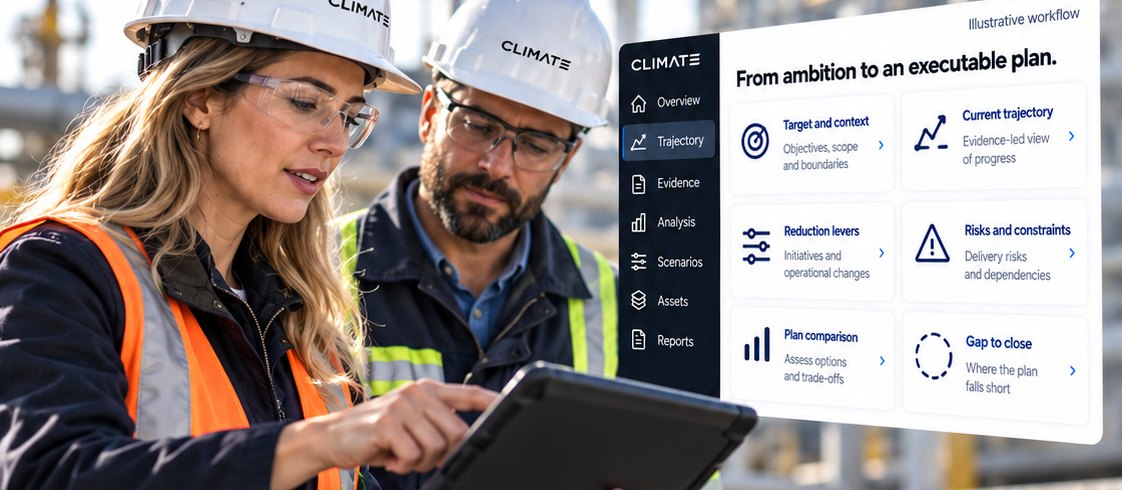
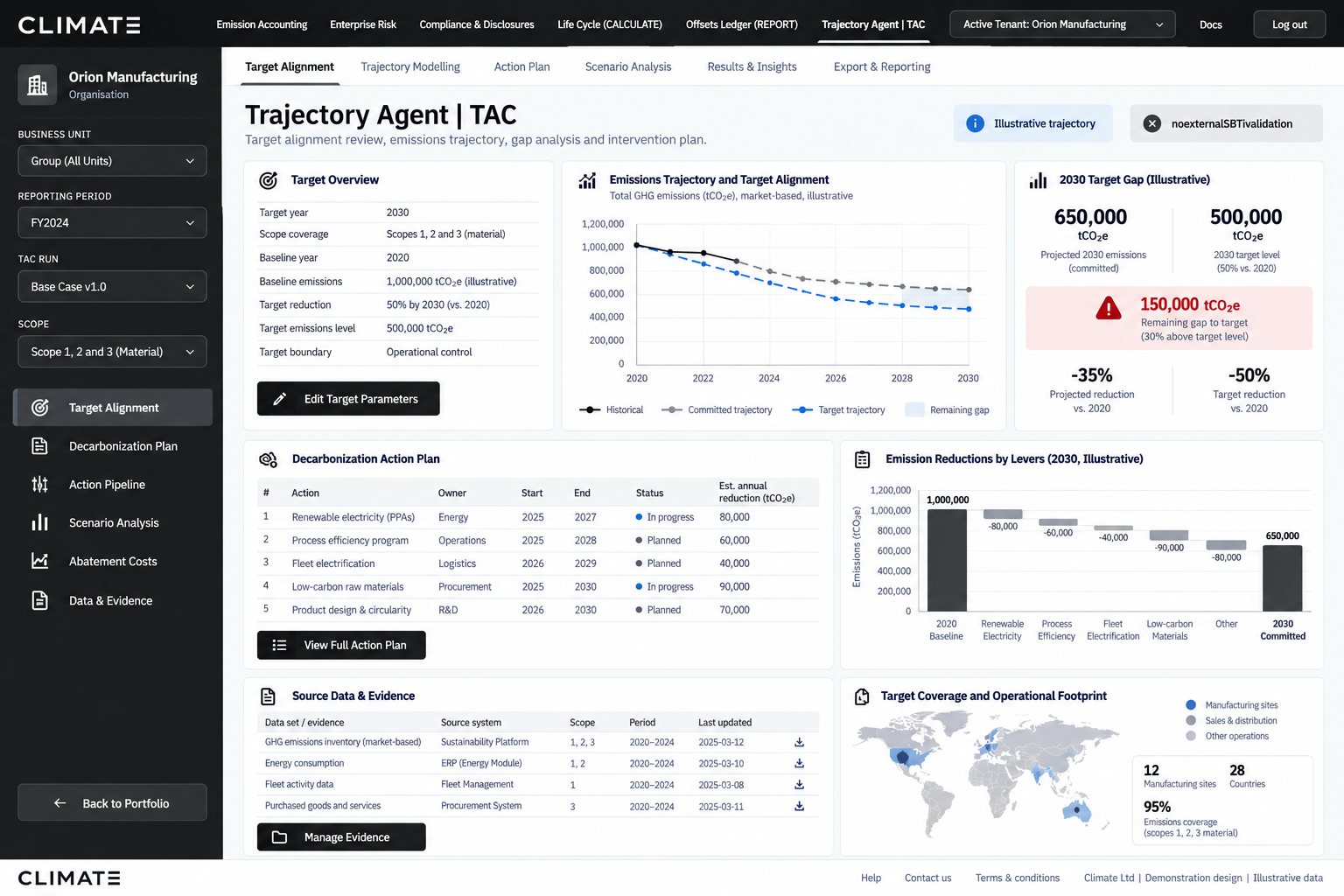
Targets become more useful when they are tested against the reduction programme. TAC overlays the net-zero trajectory on the abatement curve to identify where planned reductions fall short.
Inputs
Baseline inventory, target scope and year, emissions trajectory, committed or proposed reduction measures and their timing.
How it works
Compare the trajectory with the available abatement programme. Flag the remaining gap and revisit the assessment when the inventory, prices or project pipeline changes.
Simplifies the work
Keeps target progress connected with the evidence behind the plan. Teams can distinguish an ambition from the measures currently expected to deliver it.
Outputs
A target-alignment view showing the shortfall that requires additional action or review.
Robustness in practice
Check the baseline, target boundaries and treatment of growth, acquisitions and offsets. Review feasibility and delivery status. A target-alignment calculation does not constitute external target validation.
Financial Impact: Bring climate into financial decisions
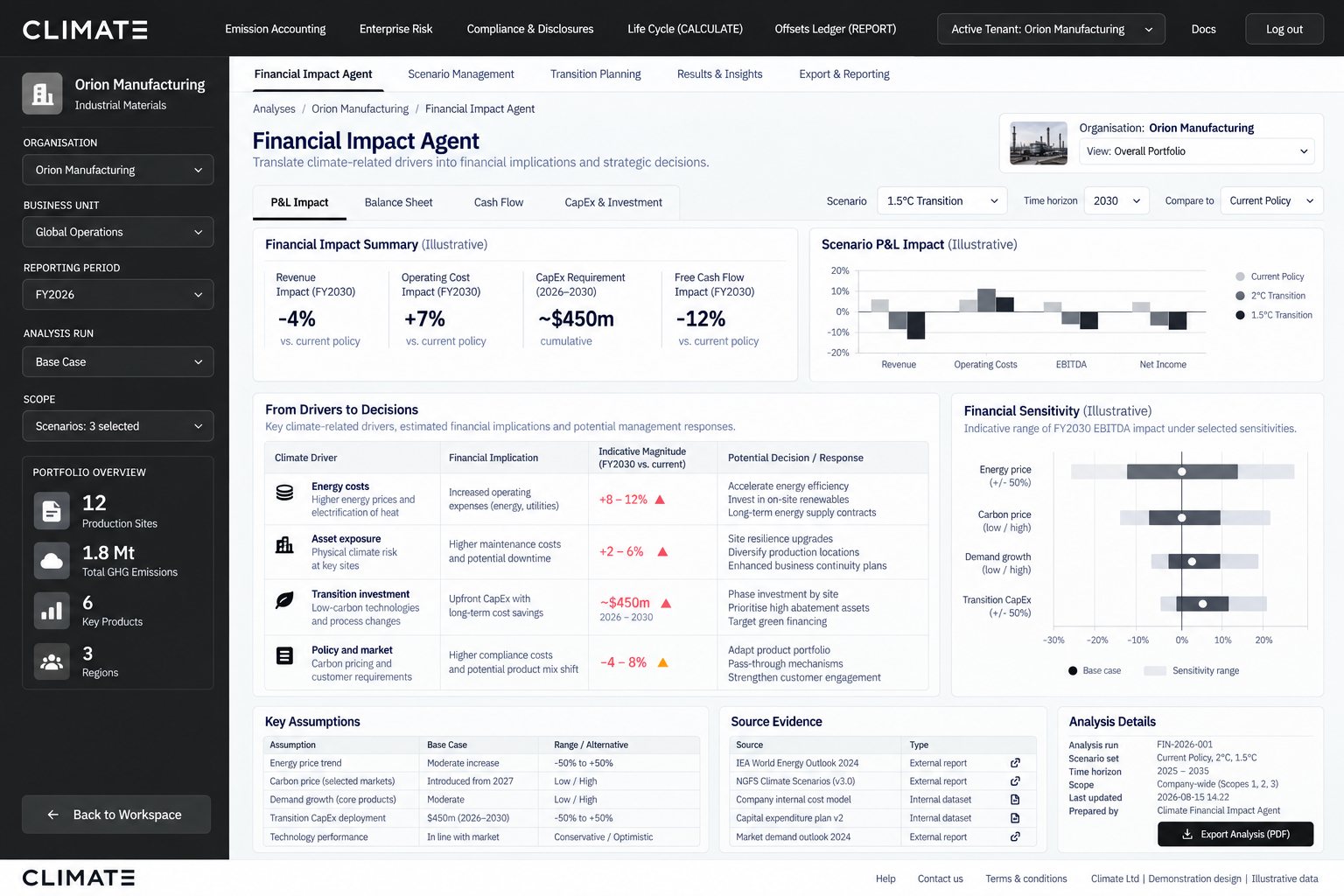
The Financial Impact Agent translates the ledger, risk exposures and abatement curve into balance-sheet and P&L terms, helping teams move from climate findings to the business implications they need to assess.
Inputs
Inventory and risk outputs, abatement options, asset and entity information, financial baselines and selected scenario assumptions.
How it works
Explore climate value-at-risk, stranded-asset exposure and transition capital needs at entity or portfolio level. Trace the analytical basis and discuss implications with finance and risk specialists.
Simplifies the work
Provides a connected basis for examining operating costs, cash-flow sensitivities and capital choices. Findings can inform board discussion and the reviewed disclosure narrative.
Outputs
Modelled implications linked to climate drivers, helping finance examine EBITDA, cash-flow and CapEx sensitivities and questions about borrowing costs and capital. Assumptions remain available for review.
Robustness in practice
Reconcile financial inputs and examine sensitivity to timing and business responses. Avoid double counting. Outputs do not automatically determine impairment, valuation or credit decisions.

Disclosure: Prepare reporting from the shared evidence
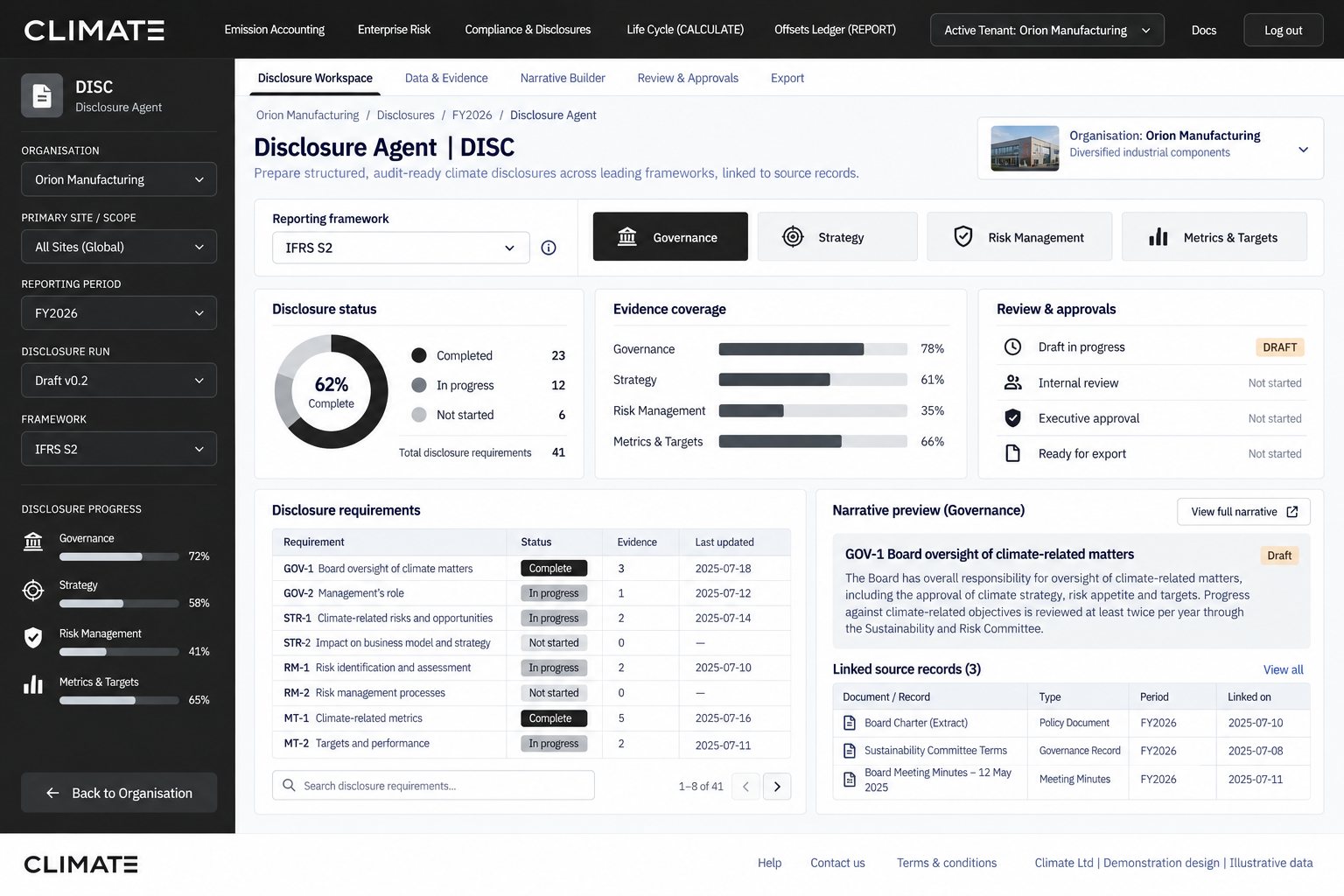
Disclosure can draw on the same inventory, risk and planning records used for management decisions. DISC assembles reporting content and readiness checks while teams retain responsibility for interpretation and approval.
Inputs
Reviewed inventory, risk outputs, plans, financial interpretation and the governance information needed for the relevant reporting scope.
How it works
Map shared records to reporting structures: IFRS S1 and S2, AASB S2 / ASRS, ESRS / CSRD, TCFD, CDP and PCAF, with jurisdictional overlays and reporting by entity or portfolio segment.
Simplifies the work
Reduces the rebuilding of evidence between analysis and disclosure. Readiness checks and recurring board reports support review throughout the year, not only at filing time.
Outputs
Reviewable disclosure drafts, readiness information and reports with links to the underlying evidence.
Robustness in practice
Confirm applicable requirements, version and scope before configuring a filing. Review materiality, narrative consistency, exclusions and approvals. Software mapping is not a legal determination or a guarantee of compliance.

Climate Copilot: Ask the question and inspect the source
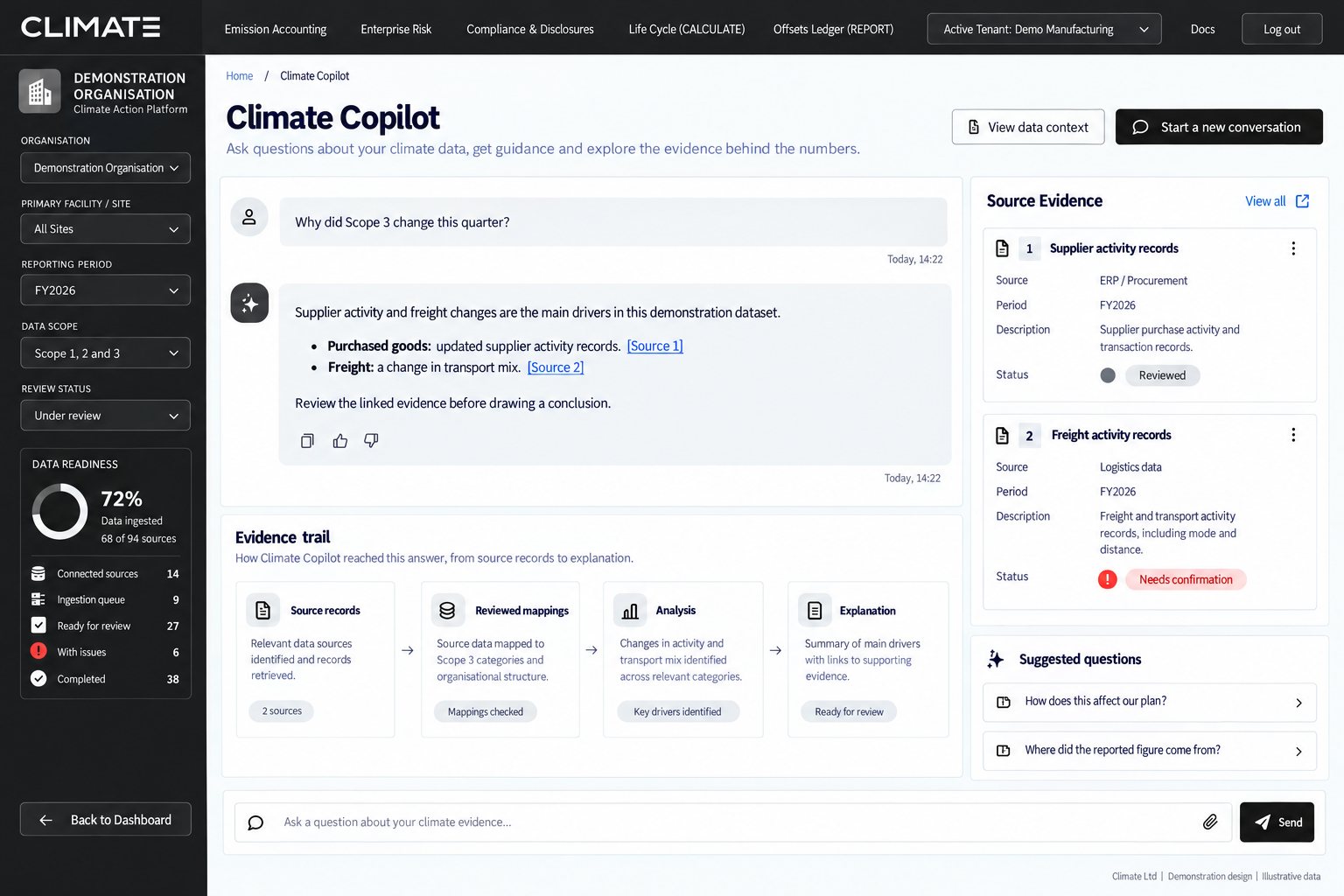
Copilot is the plain-language interface to the same data spine used by the other agents. It helps users investigate records and outputs without separating the answer from its supporting evidence.
Inputs
The shared inventory, modelled outputs and source records available within the configured platform scope.
How it works
Ask where a reported figure came from, why a number changed or what is driving an exposure. Copilot answers with source records cited for investigation.
Simplifies the work
Helps specialists and decision makers explore a common evidence base, shortening the search for relevant records and preparing a more informed conversation between operations, finance and advisers.
Outputs
Plain-language explanations that direct users back to the records behind an answer.
Robustness in practice
Open the cited evidence and challenge unsupported interpretations. An answer can only be as useful as the available records and reasoning. Retain expert review for material conclusions.

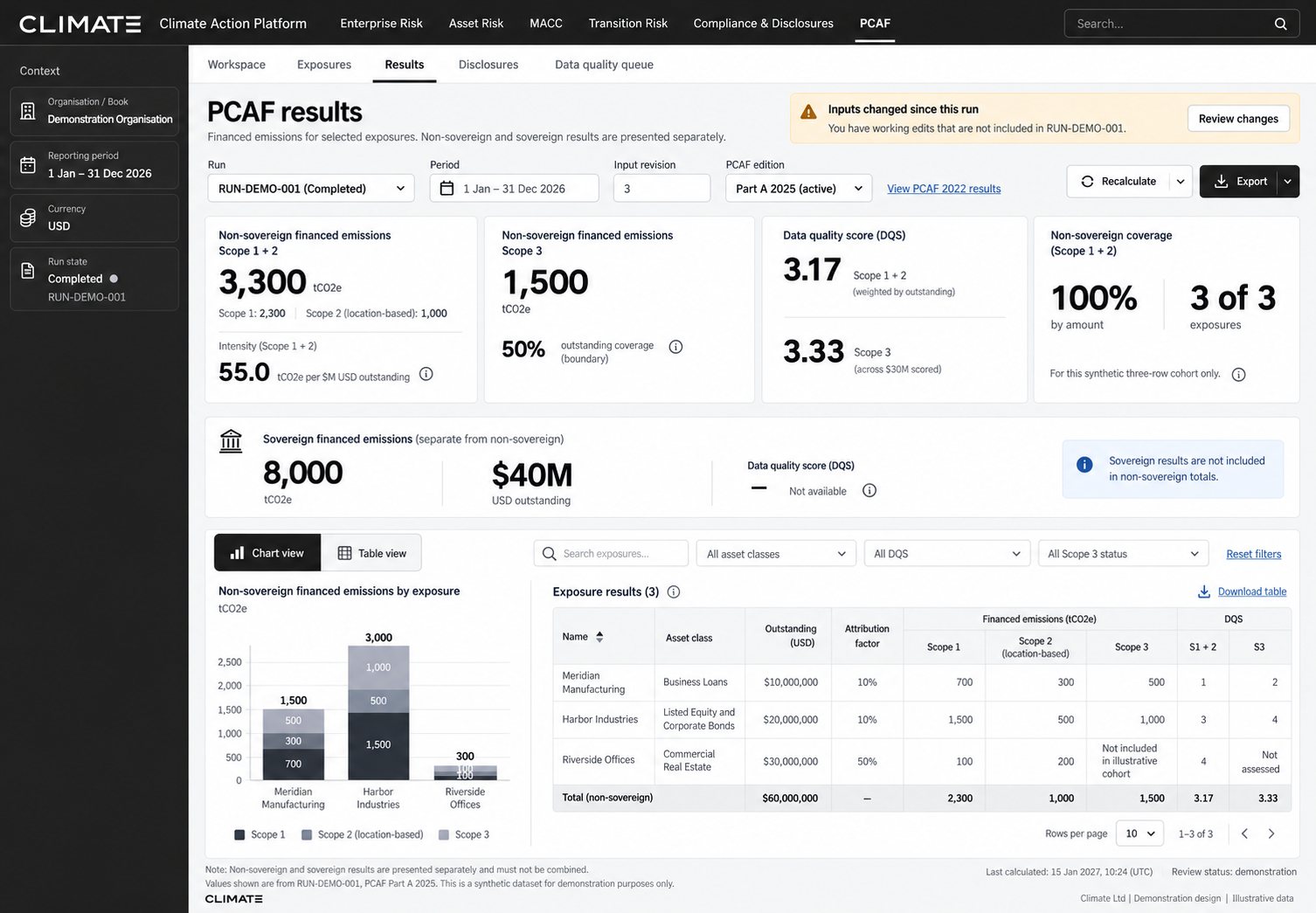
PCAF: Connected financed-emissions evidence
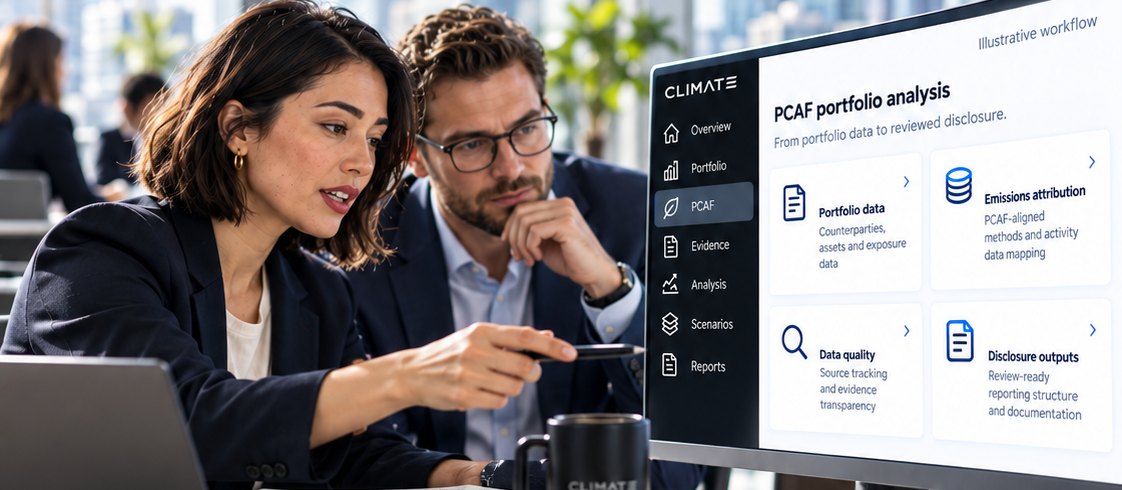
A portfolio workflow for financial institutions and their advisers, built around consistent inputs, attribution methods and data-quality transparency.
Inputs
Counterparty and exposure data, emissions evidence, ownership and portfolio relationships.
How it works
Classify exposures, apply the relevant PCAF asset-class approach, review data quality and coverage, then prepare reviewed portfolio reporting.
Simplifies the work
Portfolio accounting and portfolio risk share evidence while answering different questions. Input changes are flagged so stale runs are not silently reused.
Outputs
Financed-emissions results with attribution inputs, data-quality scores and coverage.
Robustness in practice
PCAF Part A addresses financed emissions; Parts B and C address facilitated and insurance-associated emissions. Confirm part, edition and asset classes in discovery. Financed emissions are not a credit-risk measure.
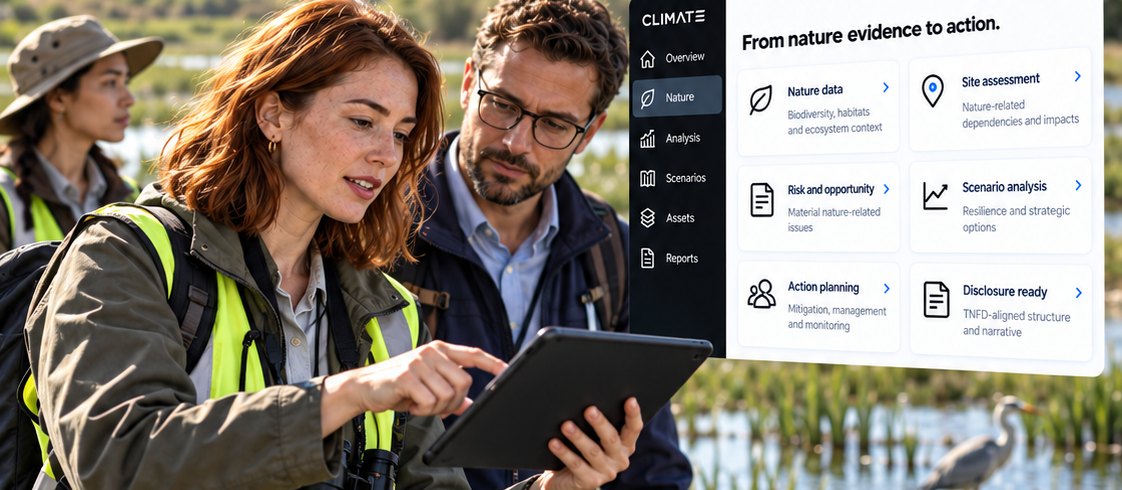
TNFD: Connect nature evidence with action
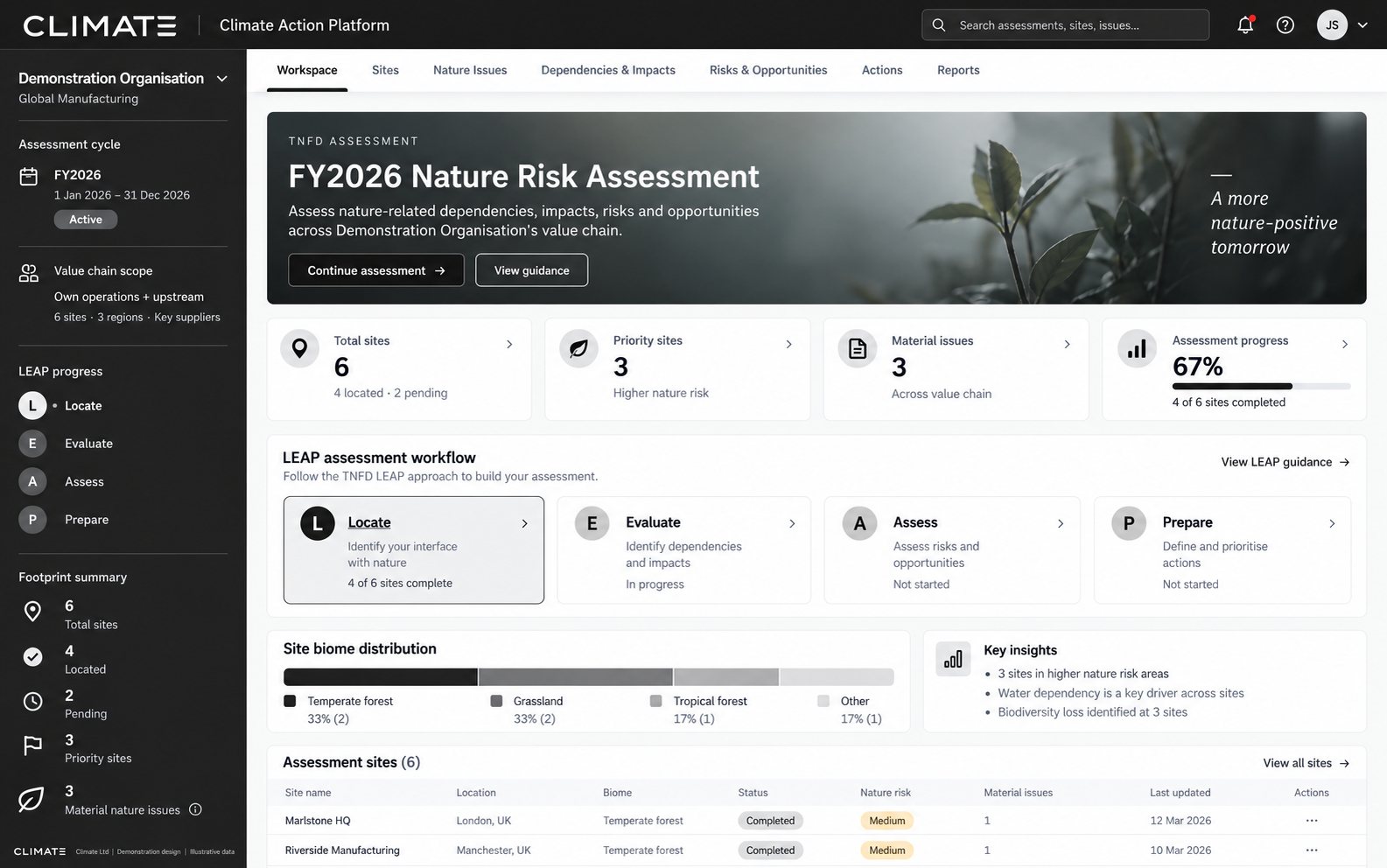
A scoped application of the shared data approach to nature-related dependencies, impacts, risks and opportunities, following the LEAP approach: Locate, Evaluate, Assess, Prepare.
Inputs
Site locations, value-chain relationships, nature evidence and monitoring records.
How it works
Locate interfaces with nature, evaluate dependencies and impacts, assess risks and opportunities with a likelihood and magnitude matrix, then prepare reporting.
Simplifies the work
Shared collection, gap review and financial interpretation, with nature specialists guiding the assessment.
Outputs
Site register, material-issues register and evidence-linked reporting around governance, strategy, risk and impact management, and metrics and targets.
Robustness in practice
A climate dataset alone does not establish a complete nature assessment. Agree datasets, ecological expertise and workflows before implementation.
Water: Water as a decision domain
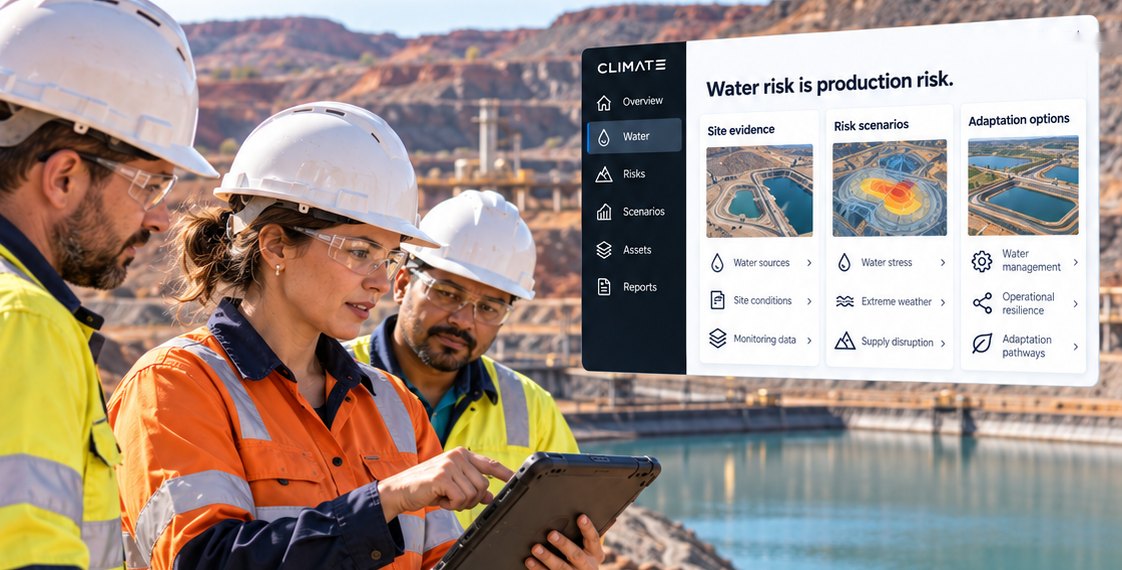
The Water capability connects water dependency, stress, availability, asset exposure and supplier context to the same evidence and decision architecture.
Inputs
Site and supplier locations, water use and availability data, asset records.
How it works
Assess water dependency and stress at site and value-chain level and test scenario-informed business implications alongside physical and transition risk.
Simplifies the work
Water risk is reviewed with energy, heat and supply risk instead of in a separate study.
Outputs
Water-exposure views by site and supplier with assumptions available for review.
Robustness in practice
Implementation scope, datasets, hydrological methods and jurisdiction-specific requirements are confirmed during discovery.
Bring one climate workflow. We will show how the agents connect it.
Start with an emissions inventory, a physical-risk assessment, a PCAF portfolio, a TNFD scope, a water-risk question, a disclosure programme or a client advisory workflow.
Request a demo